Showing posts with label Recipe. Show all posts

Sunday, April 25, 2021

Chitra Pournami is a festival dedicated to the worship of Lord Chitragupta with recipe of Sarkarai Pongal

 Chitra Pournami is a unique festival celebrated across Tamil Nadu dedicated to the worship of Chitragupta. Chitra Pournami is celebrated on the full moon day of the month of April-May (Chitirai Masam in Tamil), believed to be his birthday.  This year it falls on 26th &27th April. The pournami  thithi  starts on 26th afternoon and ends on 27th morning.


Chitragupta is said to diligently record and maintain the account of the good and bad actions performed by every human being who is born on this earth. On the completion of a person’s life time, Chitragupta prepares the final report to be presented to Lord Yama. This forms the basis for the God of Death to decide the fate of that particular individual.
People celebrate this festival by taking bath in holy rivers to wash off their sins and offer special pujas and prayers at temples. Interestingly, some of the temples dedicated to worship of Chitragupta are the Chitragupta Temple on Nellukara Street, Kanchipuram, Chitragupta Mahadeva Devalayam in Hyderabad, Chitragupta temple at Kajuraho, and Chitragupta Maharaj Temple at Chitragupta Ghat on the banks of the Gandak river in Hajipur, Bihar.
In the temple at Kanchipuram, the main deity of Shri Chitragupta is depicted in a seated position with a palm leaf in his left hand and a pen in his right hand. The utsava murthy  of the Lord with his wife Karnika Ambal is beautiful.  Priests and devotees offer Sarkarai Pongal and other delicacies without salt as neivedyam for the Lord.
There is another legend associated with this festival pertaining to Lord Indra and his Guru, Brihaspathi. The story goes that they had an argument, after which the Dev Guru refrained from giving advice to Lord Indra.  Bereft of the wisdom and proper advice of his Guru, Lord Indra committed various sins. Later he realized his folly and sincerely repented for his mistakes. Out of sympathy and compassion the Dev Guru resumed his duties and advised Devraj Indra to undertake a pilgrimage on Earth. After a long journey, at a certain place, Devraj Indra sensed that he had been redeemed of his sins. He found a Shivalingam under a Kadamba tree and wanted to offer puja to the Lord in gratitude. He looked around and surprisingly, in a pond nearby, he found a golden lotus. He worshipped the Lord with the golden lotus. The place was the holy city of Madurai and the day was the auspicious Chitra Pournami day. Even today this divine event is commemorated with an Indra Puja on Chitra Pournami day at the Madurai Meenakshi temple.
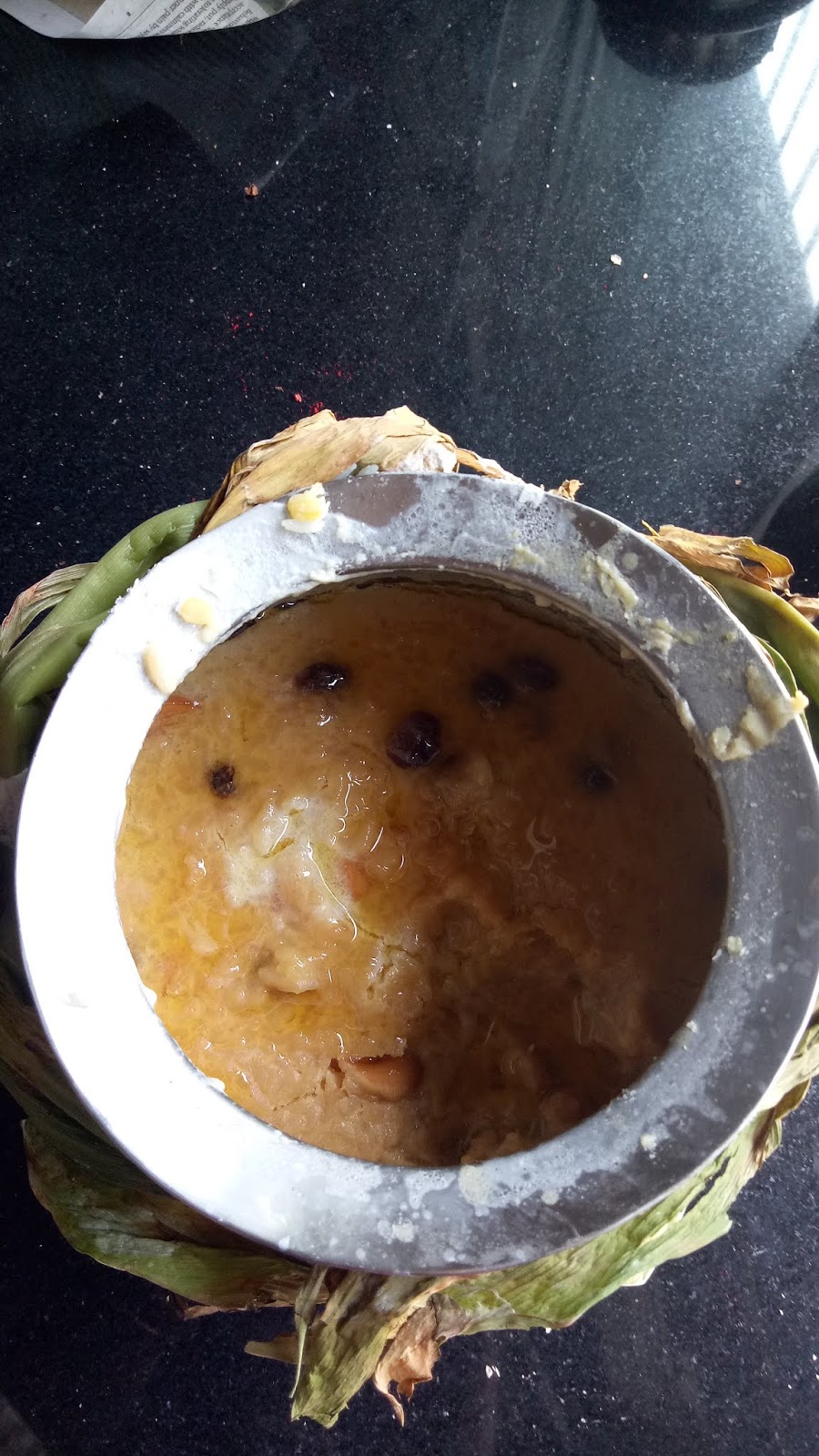
Here is the Recipe of Sarkarai Pongal which is the main neivedhyam offered to Lord Chitragupta on Chitra Pournami day.
Sarkarai Pongal


Ingredients:
Raw Rice – 1 cup
Yellow Moong Dhal – 1/4 cup
Milk – 1/2 cup
Water - 2 cups
Jaggery – 2 cups (grated)
Cashews – 3 tablespoons
Raisins – 3 tablespoons
Powdered Cardamom – ½ teaspoon
Ghee – 3 tablespoons


Method:
Roast the moong dhal in a teaspoon of ghee till it slightly changes color. Remove on to a bowl and soak it along with raw rice in water for 10 minutes. Strain it to remove water.
Take a vessel and boil milk. Add  the soaked and strained rice and dhal to the milk and water and cook  till the rice is fully cooked. Mash it up with a spoon and keep aside. Alternatively you can cook the rice, dhal with milk and water with a teaspoon of ghee in a pressure cooker for 4 or 5 whistles. 
In a separate bowl add the jaggery to water and bring to a boil. Strain to remove impurities. Add this jaggery water to the milk, rice and dhal mixture. Stir well on a low flame till they are completely mixed.
Take a pan and pour the rest of the ghee in it. Fry Cashews and raisins in the ghee to a golden brown and add to the pongal mixture. Stir on low flame till they blend well. Add cardamom powder and mix.
Your Sakkarai Pongal offering is ready.

#ChitraPournami #Chitragupta #Kanchipuram #SarkaraiPongal #Recipe

Thursday, March 11, 2021

Nolumbu special - Recipe for Sweet Karadai and Salted Karadai


Karadayan Nombu falls on Sunday,14th March, this year and according to learned priests the time specified for tying the yellow thread is between 3.30 pm and 4.30 pm. Celebrated by the people of Tamil Nadu, married women perform puja and pray for the long life of their husbands and unmarried girls pray for getting blessed with a good husband. The puja is performed at a specified time, just when the Tamil month of Maasi ends and the month of Panguni begins.


Tradition

On this day the women get up early in the morning, take bath and decorate their house entrance and the puja room with kolams. They place leaves in front of the Goddess on which they offer betel leaves and areca nuts (Vethalai Pakku), yellow bananas, sweet Karadai and butter. Traditionally, the women fast until the specified time of the puja, wear nine yards sari, adorn their hair with flowers, tie the manjal charadu (yellow thread) and pray for the long life of their husbands.


 While tying the manjal charadu, the mantram chanted is


“Dhram gruhnami subhage sahardhraam

Dharami aham bharthu

Ayushya sidhartham supreedha bhava sarvadha”  

This means, “I am taking the thread, Oh Goddess, with affection,

And I am wearing it for the long life of my husband.

Always be pleased with me.”


The Tamil chant during the puja while offering the Karadai to the Goddess is

“Urugadha vennaiyum, oru adaiyum notrein,

Orukkalum en Kanavar ennai piriyadhirukka vendum”

Meaning “I offer this unmelted butter and adai. Please bless me to live with my husband forever.”

Generally the women break their fast by eating the prasad of sweet karadai with butter after they have performed the puja and offered it to the Goddess.


Recipe for Sweet Karadai also known as Nolumbu Adai


Ingredients


Dry roasted rice powder - 1 cup

Jaggery powdered -  1 cup

Water - 2 cups

Coconut slices - 1 tablespoon

Karamani (Black eyed peas/ lal chowli) - 1 or 2 tablespoons     

Cardomom - 1 pinch

Ghee - 1 teaspoon


Method of preparation

Wash and soak raw rice in water for 3 to 4 hours. Drain the water and spread the rice on a cloth for 15 minutes. Then grind it to a fine powder. Dry roast this powder till there is no moisture.


Cook the Karamani separately till soft and keep aside.


Take a pan and melt the jaggery in 2 cups of water. Filter to remove dirt or impurities. Add the fine small sliced coconut pieces, the Karamani and boil. When the jaggery water starts boiling, add a teaspoon of ghee. the cardomom powder and then the roasted rice powder while stirring continuously till the mixture leaves the sides of the pan. Off the burner and allow it to cool.

Roll the mixture into balls, flatten them and make holes in the middle as shown in the picture. Now steam the sweet karadais in an idli cooker for 15 minutes.

Your sweet Karadai is ready to serve with butter.


The recipe for Salted Karadai


Ingredients

Dry roasted rice powder

Salt to taste

Karamani - 1 or 2 tablespoons

Coconut slices


Seasoning

Oil - 1 tablespoon

Mustard - 1/2 teaspoon

Udad dal - 1/4 teaspoon

Curry leaves - a few

Green chilli - 1 or 2 finely chopped

Ginger - a small piece finely chopped.

Asefoetida - a pinch


Method of Preparation


Prepare the rice powder and cook the karamani in the same way as for the sweet Karadai

Heat the oil in a saucepan and add mustard. Let it sputter. Add udad dal, asefoetida, and chopped ginger and green chillies. Then add the curry leaves. Now add the coconut finely sliced and karamani. Add water and salt to taste. Bring it to a boil. When the water starts boiling, lower the flame and add the rice powder slowly and stir continuously till the mixture leaves the sides of the pan. Allow it to cool. Then like the sweet Karadai, divide it into balls, flatten them and carve a hole in the middle of each. Steam these salted adais in an idli cooker or steamer and your salted karadais are ready to serve.


For those who want to know more here is the story behind this festival.

 Legend 

The story goes that Maharaja Ashtapathi had a beautiful daughter named Savitri, whom he adored. He knew her to be very intelligent and wise and gave her the freedom of choosing her husband. Savitri, during one of her visits to the forest, came upon a young man who was carrying on his shoulder, his blind parents in two baskets slung on a pole. Savitri was impressed by his sense of duty and respect and decided to marry him. When she informed her father, Ashtapathi enquired about the young man with Narada Muni. Narada informed him that the young man was Satyavan, the son of a king who had been exiled from his own kingdom. Ashtapati was happy about the fact that his daughter had chosen a prince. But then Narada said that Satyavan would die young. He had only one year to live. The King was aghast. But Savitri was set on marrying Satyavan. The King had no option but to get them married. Savitri was well aware about her husband’s impending death. She undertook strict vrats and performed pujas with dedication. The fateful day dawned. While cutting wood, Satyavan fell dead as Yama, the Lord of Death had arrived. Savitri followed Yama. The God of Death was astonished and pleased by her perseverance. He offered her three boons, and said that she should not ask for her husband. Savitri, being intelligent, agreed. She first asked that her in laws should be reinstated in their kingdom with all glory and respect. Her second request was for a son for her father Ashtapathi. For the third boon she asked for sons for herself. Yama said “Granted” and then realized that he had been outwitted by her intelligence, as he had to leave Satyavan alive for Savitri to beget sons.  The time of Karadayan Nombu is believed to be the time when Savitri performed puja, offered the Karadai to Lord Yama and got her husband back from death. Thus the offering of the delicious Karadai, both sweet and salted, is unique to this festival.


#KaradayanNombu #festival #SweetKaradai #SaltedKaradai #recipe #TamilNadu #SavitriVrat, #Nolumbu #Savitri #Satyavan #legend


Sunday, July 19, 2020

#Aadi month, #BhagavathiSevai and delicious #NeiPayasam


During the Aadi masam, it is common for people to perform Bhagavathi Sevai puja at their homes to worship the Goddess mother. The priest (Vadhyar) draws the Padmam himself and decorates it with yellow turmeric powder and red Kumkumam. The vilakkus (either two or three as per the tradition of each house) are then decorated with flower garlands, chandanam(sandal paste) and kumkumam. They are filled with ghee and lit. The puja starts with the invocation of Lord Ganesh. This is followed by invocation of Goddess Parashakthi. Lalitha Sahasranamam, Lalitha Thrisithi Mantram, Durga Sooktham, and some chapters from the Devi Mahatmyam (Durga Sapta Shathi) are chanted, while offering various types of flowers to the Goddess.  The atmosphere is divine and one can actually feel the presence of the Devi when the puja is performed with sincerity and devotion. 


There are two neivedyams offered during this puja, the delicious Nei Payasam and Ulundu Vadai. The neivedhyam is then offered as prasadam to all those who are attending the puja.


Here is the recipe for the Nei Payasam
Ingredients
Raw Rice – 250 gms.
Jaggery - 1 Kg.
Ghee – ½ Kg
Cardamom – 6-8 crushed to powder
Fresh coconut – finely sliced ½ cup
Method of Preparation
First sauté the thinly sliced coconut pieces in ghee till they turn slightly brown. Keep aside.
Wash the rice well and cook.
Powder the jaggery/vellam/gud (you can use powdered vellam available in grocery stores). Take the jaggery in water just enough to dissolve in a thick bottomed vessel or Kadhai.
Boil it till all the jaggery melts and dissolves into syrup. Strain for impurities.
Add the cooked rice to the jaggery syrup and stir continuously while adding ghee little by little. You have to ensure that no lumps are formed. The mixture will thicken as you keep stirring. It will slowly start leaving the sides of the vessel. Add the powdered cardamom and the coconut slices.
The delicious Nei payasam for neivedyam is ready.
(For a variation you can sauté some cashew and raisins in ghee along with the coconut slices. It tastes really good.)  


#Aadi #Bhagavathi_Sevai #Nei_Payasam #recipe

Friday, March 13, 2020

#KaradayanNombu significance, story and #recipes #Festival 6

Karadayan Nombu/Nolumbu, or Savitri vratham as it is also known, is one of the most important festivals for women of Tamil Nadu. On this day, married women perform puja and pray for the long life of their husbands and unmarried girls pray for getting blessed with a good husband. The puja is performed at a specified time, just when the Tamil month of Maasi ends and the month of Panguni begins. Karadayan Nombu falls on 14th March this year.  On this day the women get up early in the morning, take bath and decorate their house entrance and the puja room with kolams. They place leaves in front of the Goddess on which they offer betel leaves and areca nuts (Vethalai Pakku), yellow bananas, sweet Karadai and butter. Traditionally, the women fast until the specified time of the puja, wear nine yards sari, adorn their hair with flowers, tie the manjal charadu (yellow thread) and pray for the long life of their husbands.

 While tying the manjal charadu, the mantram chanted is

“Dhram gruhnami subhage sahardhraam
Dharami aham bharthu
Ayushya sidhartham supreedha bhava sarvadha”  


This means, “I am taking the thread, Oh Goddess, with affection,
And I am wearing it for the long life of my husband.
Always be pleased with me.”

The Tamil chant during the puja while offering the Karadai to the Goddess is

“Urugadha vennaiyum, oru adaiyum notrein,
Orukkalum en Kanavar ennai piriyadhirukka vendum”

Meaning “I offer this unmelted butter and adai. Please bless me to live with my husband forever.”

Generally the women break their fast by eating the prasad of sweet karadai with butter after they have performed the puja and offered it to the Goddess.

The legend behind this festival is the widely known story of Savitri, with her intelligence and perseverance succeeding in getting her husband Satyavan from Yama, the God of death.

The story goes that Maharaja Ashtapathi had a beautiful daughter named Savitri, whom he adored. He knew her to be very intelligent and wise and gave her the freedom of choosing her husband. Savitri, during one of her visits to the forest, came upon a young man who was carrying on his shoulder, his blind parents in two baskets slung on a pole. Savitri was impressed by his sense of duty and respect and decided to marry him. When she informed her father, Ashtapathi enquired about the young man with Narada Muni. Narada informed him that the young man was Satyavan, the son of a king who had been exiled from his own kingdom. Ashtapati was happy about the fact that his daughter had chosen a prince. But then Narada said that Satyavan would die young. He had only one year to live. The King was aghast. But Savitri was set on marrying Satyavan. The King had no option but to get them married. Savitri was well aware about her husband’s impending death. She undertook strict vrats and performed pujas with dedication. The fateful day dawned. While cutting wood, Satyavan fell dead as Yama, the Lord of Death had arrived. Savitri followed Yama. The God of Death was astonished and pleased by her perseverance. He offered her three boons, and said that she should not ask for her husband. Savitri, being intelligent, agreed. She first asked that her in laws should be reinstated in their kingdom with all glory and respect. Her second request was for a son for her father Ashtapathi. For the third boon she asked for sons for herself. Yama said “Granted” and then realized that he had been outwitted by her intelligence, as he had to leave Satyavan for Savitri to beget sons.  The time of Karadayan Nombu is believed to be the time when Savitri performed puja, offered the Karadai to Lord Yama and got her husband back from death.

The offering of the delicious Karadai, both sweet and salted, therefore is unique to this festival.

Here is the Recipe for Sweet Karadai


Ingredients

Dry roasted rice powder - 1 cup
Jaggery powdered -  1 cup
Water - 2 cups
Coconut slices - 1 tablespoon
Karamani (Black eyed peas/ lal chowli) - 1 or 2 tablespoons     
Cardomom - 1 pinch
Ghee - 1 teaspoon

Method of preparation
Wash and soak raw rice in water for 3 to 4 hours. Drain the water and spread the rice on a cloth for 15 minutes. Then grind it to a fine powder. Dry roast this powder till there is no moisture.

Cook the Karamani separately till soft and keep aside.

Take a pan and melt the jaggery in 2 cups of water. Filter to remove dirt or impurities. Add the fine small sliced coconut pieces, the Karamani and boil. When the jaggery water starts boiling, add a teaspoon of ghee. the cardomom powder and then the roasted rice powder while stirring continuously till the mixture leaves the sides of the pan. Off the burner and allow it to cool.
Roll the mixture into balls, flatten them and make holes in the middle as shown in the picture. Now steam the sweet karadais in an idli cooker for 15 minutes.
Your sweet Karadai is ready to serve with butter.

The recipe for Salted Karadai


Ingredients
Dry roasted rice powder
Salt to taste
Karamani - 1 or 2 tablespoons
Coconut slices

Seasoning
Oil - 1 tablespoon
Mustard - 1/2 teaspoon
Udad dal - 1/4 teaspoon
Curry leaves - a few
Green chilli - 1 or 2 finely chopped
Ginger - a small piece finely chopped.
Asefoetida - a pinch

Method of Preparation

Prepare the rice powder and cook the karamani in the same way as for the sweet Karadai
Heat the oil in a saucepan and add mustard. Let it sputter. Add udad dal, asefoetida, and chopped ginger and green chillies. Then add the curry leaves. Now add the coconut finely sliced and karamani. Add water and salt to taste. Bring it to a boil. When the water starts boiling, lower the flame and add the rice powder slowly and stir continuously till the mixture leaves the sides of the pan. Allow it to cool. Then like the sweet Karadai, divide it into balls, flatten them and carve a hole in the middle of each. Steam these salted adais in an idli cooker or steamer and your salted karadais are ready to serve.

#KaradayanNombu #festival #SweetKaradai #SaltedKaradai #recipe #TamilNadu #SavitriVrat, #Nolumbu #Savitri #Satyavan

Monday, January 13, 2020

#Pongal celebrations in Tamil Nadu #Festival 5


We, South Indians, await our main festival Pongal with great glee in the month of January, as this is the time we get to interact with family, cousins and extended family members. This year, Pongal celebrations fall between 14th to 17th January, it is the time we reverently worship the forces of nature like the Sun and the rain and thank them for giving us a plentiful harvest. 
Lord Indra gives us adequate rain. Dedicated to Lord Indra, the first day of Bhogi pongal, as this tradition is called, is full of joy and merriment. It is fascinating to watch young girls dance around a bonfire kept burning with mud, wood and cowdung. 

Prayers are offered to the Sun God on the second day marking the main festival of Pongal. On this day we create beautiful rangolis with rice flour in front of the house and wear new traditional clothes. We wait for the auspicious time, to tie a turmeric plant around a curved pot and decorate it with haldi kumkum. Milk is allowed to boil and overflow in this vessel symbolically for prosperity and well being to overflow in the family. A delicious sweet porridge of milk, rice, dhal and sugar is prepared as offering for the Sun God along with sugarcane, and the mandatory betel leaves, betel nuts, coconut and yellow bananas.  
Mattu Pongal follows on the third day when prayers are offered to the cows which help the farmers in so many ways. Everywhere in Tamil Nadu, we can see colorful sights of cows decorated with garlands and tilak wearing a string of colourful beads and bells around the cow’s neck. Puja and arati is performed. The famous Jalli kattu or bull fight is also organized in villages. Kannum Pongal is a traditional feature on the final day, when a turmeric leaf is washed and kept in the open courtyard on which rice, betel leaves, nuts, turmeric, coconut etc. are placed. In some places, arati is performed for the brothers by the sisters, who pray for the prosperity of their families.
As we all know no festival is complete without food delicacies and Pongal is no exception. The Sakkarai Pongal and the Venn Pongal are symbolic of the festival, simple and delicious, yet highly nutritious too.
Here are the recipes for you to prepare and enjoy.
Sakkarai Pongal

Ingredients:
Raw Rice – 1 cup
Yellow Moong Dhal – 1/4 cup
Milk – 1 litre
Jaggery – 2 cups (grated)
Cashews – 3 tablespoons
Raisins – 3 tablespoons
Powdered Cardamom – ½ teaspoon
Ghee – 3 tablespoons


Method:
Roast the moong dhal in a teaspoon of ghee till it slightly changes color. Remove on to a bowl and soak it along with raw rice in water for 10 minutes. Strain it to remove water.
Take a vessel and boil milk. Add  the soaked and strained rice and dhal to the milk and cook on low flame till the rice is cooked. Mash it up with a spoon and keep aside.
Add the jaggery to water and bring to a boil. Strain to remove impurities. Add this jaggery water to the milk, rice and dhal mixture. Stir well on a low flame till they are completely mixed.
Take a pan and pour the rest of the ghee in it. Fry Cashews and raisins in the ghee to a golden brown and add the pongal mixture. Stir on low flame till they blend well. Add cardamom powder and mix.
Your Sakkarai Pongal is ready to serve.
Venn Pongal

Ingredients


Yellow Moong Dhal – 1/2  cup
Raw Rice -  3/4 cup
Ghee – ¼ cup
Cashew nuts – 2 tablespoons
Ginger sliced or minced – ½ teaspoon (optional)
Green chilly chopped -1 (optional)
Cumin seeds – 1 teaspoon
Black pepper – 1 teaspoon
Curry leaves - 1 sprig
Salt to taste
Method
Roast the moong dhal in a teaspoon of ghee till it slightly changes color and gives off a lovely smell. Remove on to a bowl and soak it along with raw rice in water for 10 minutes. Cook the dhal and rice together in a pressure cooker with 3 ½ cups of water for 6 to 7 whistles. Grind the pepper and cumin to a coarse powder after dry roasting.
 Heat the ghee in a pan. Fry the broken cashew nuts to a golden brown. Add ginger, curry leaves and green chilly (optional). Roast on a low flame. Add in the pepper-cumin mixture and roast for a few seconds. Pour the cooked rice-dhal mixture and add salt to taste. Stir till the entire mixture blends well.
Your Venn Pongal is ready to serve.

#Pongal #SarkaraiPongal #VennPongal #Recipe #BhogiPandigai #MattuPongal #Jallikattu