Wednesday, April 1, 2020

#Stories from the #Ramayana on Rama Navami day #ChildrenStories 7


Maharaja Dashrath, the King of Ayodhya, had everything that his heart desired, three beautiful wives, Kaushalya, Kaikeyi and Sumitra, wealth, prosperity and happy subjects. But he had no sons to continue his lineage. The King and his queens were worried about the future of the kingdom.
They went to their Kula Guru,Sage Vasishta.
“We have everything we want in the world, but we have no children to continue our lineage. I am not going to live forever. What will happen to the people of our Ayodhya?” asked the worried King.
Sage Vasishta advised, “You can perform the puthrakameshti yagna.”
 Maharaj Dashrath immediately agreed.
 “But,” pronounced Vasishta, “There is only one person who can guide you in perfoming this yagna, and that is Sage Rishyashringa.”
As Dashrath got ready for the journey, Vasishta told him, “You and your queens have to go on foot without any encumbrage to invite the Sage.”
 Dashrath agreed and soon set out to meet Sage Rishyashringa. The Sage was pleased with the humility and respect shown by the king and agreed to do the Puthrakameshti Yagna.
At the culmination of the yagna, Agnidev appeared from the sacrificial fire with a pot of kheer in his hands. He gave the pot to King Dashrath and asked him to distribute it to his queens. Dashrath gave one part of the Kheer to Kaushalya, another to Kaikeyi and the remaining two parts to Sumitra. They returned to Ayodhya with hope in their heart and prayer on their lips. Within a few days, all the three queens became pregnant. Nine months later, the King became a father to four sons. In the month of Chaitra, on the Navami day, one son was born to Kaushalya, one to Kaikeyi and two to Sumitra. Entire Ayodhya joined the king and queens in rejoicing when the four sons of Dashratha were born. Soon Sage Vasishta had to perform the naming ceremony. He thought for some time before proclaiming that Kaushalya’s son would be named Rama.
“Why Rama?” he explained. “Because this child will give joy and happiness to everyone in the world.”
Maharaja Dashrath was very happy and he and his queens took the infant Rama in their hands one by one and whispered the name Rama in his ears.
Then Vasishta said, “The son of Kaikeyi will be named Bharata as he will protect everyone. The sons of Sumitra will be named Lakshmana and Shatrugna, as Lakshmana is auspicious and Shatrugna will be the destroyer of enemies.”
Vasishta being a great Sage and visionary, knew that Rama was the incarnation of Mahavishnu, Lakshmana of Adishesha, Bharata of the divine Conch and Shatrugna of the Sudarshanachakra.
Rama was the darling of everyone. Kaikeyi loved him more than her own son, and so did Sumitra.
One night as Kaushalya was feeding baby Rama while showing him the moon.
“Chandamama” little Rama said pointing to the moon.
 It was full moon night and the moon was very beautiful and Rama wanted it. Kaushalya first thought that he wanted more food, but when she fed him with rice he refused saying again that he wanted the moon. Kaushalya did not know what to do. Rama started crying out loud that he wanted the moon.
Hearing his cries, the King and the other queens came running. When they saw that Rama wanted the moon, they were nonplussed.
‘How to bring the moon down?’ They were in a dilemma. They tried to console the child, but in vain.
Then Kaikeyi suddenly hit upon an idea. She brought a vessel filled with water from her room and showed the reflection of the moon to Rama.
Rama was happy and his laughter made everyone happy.
Rama and his brothers grew to be strong young lads and loved playing together. Lakshmana always sided with Rama, while Shatrugna went with Bharata. Being the eldest, Rama was loved and respected by all of them and they always listened to him. Once when they were playing at bringing mangoes down from the tree, Rama and Bharata both aimed at the mangoes. The person who brought down the most number of mangoes would win. The mangoes were struck down but both felt that he was the one who had hit the mango. 
Lakshmana at once started arguing on Rama’s behalf, whereas Shatrugna maintained that it was Bharata who had struck the mango down. Rama at once calmed his brothers and declared that it was Bharata who had won. This showed his selfless love for his brothers.
The children grew up a little more and were then initiated into learning by Sage Vasishta at his gurukul. They were taught archery and martial arts along with formal education. The princes were treated as equals to all other students in the gurukul. They did not have any advantages or special treatment because they were from the royal family. And Rama and his brothers were happy with their friends and gave utmost respect to their Guru, Sage Vasishta.  

 After finishing their learning at the gurukul, Rama and his brothers returned to the palace. Maharaja Dashrath and his queens were delighted. They poured affection and love on the children and were enjoying their company to the maximum.
One day, Sage Vishwamitra arrived in Ayodhya. Maharaja Dashrath went personally to receive and welcome him to his kingdom. He washed Vishwamitra’s feet in reverence and accompanied him to the palace. Sage Vasishta who was present, also stood up reverently and welcomed  Vishwamitra Maharishi.
“Oh revered Maharishi Vishwamitra! Your sacred feet have enhanced the honour of our country. Your respected presence in our palace has made the entire Ayodhya sacred,” said Maharaja Dashrath, while welcoming the Sage into the palace court.
Vishwamitra acknowledged the respectful welcome of the King.
After ensuring that the Sage had been seated comfortably, the King went up to him and enquired, “Tell me, what can I do for you?”
“Are you sure that you will give me what I want?” asked Vishwamitra.
“If it is in my capacity, I promise that I will offer you whatever you require,” answered Dashrath.
“I will not take no for an answer anyway,” said the Sage. “I want Rama and Lakshmana to accompany me to the forest. We are doing yagnas for the wellbeing of the world, but there are two demons who disrupt our yagnas. I need Rama and Lakshmana to defeat those demons so that we can complete our yagnas in peace.”
Maharaja Dashrath was stunned. He had never expected such a request from the Sage. The children had just come back home after a few years of stay and learning at the gurukul. How could he part with his beloved Rama again? How would the queen mothers take it? Dashrath mind was floundering for an answer to the Sage.
Vishwamitra waited for a few seconds. Then he got up and said angrily, “Maharaja Dashrath, I thought you were a man who stood by his word. You promised me that you would give me what I want. Then why are you not answering?”
Dashrath pleaded with the Sage, “Maharishi, Rama and Lakshmana are too young to fight with demons. Let me accompany you and I assure you that I will fight with those demons. I will see that you are allowed to perform your yagnas in peace.”
The Sage refused to listen. “I don’t want you. I want Rama and Lakshmana. If you cannot give them, let me leave. I don’t want anything else,” he exclaimed angrily.
Knowing the effect of the anger of Sage Vishwamitra, Vasishta came forward.
“Maharaja Dashrath, You speak like this because you are not aware of the real caliber of Rama and Lakshmana. As a Guru, I can vouch for their exceptional power and capability. And though I have taught them whatever I could, by being with Brahmarishi Vishwamitra, who has so much more knowledge to impart and so many divine asthras in his repertoire, they can acquire much more gyaan.”
Dashrath gave in and sent for Rama and Lakshmana. Vishwamitra was waiting for this moment when he could set his eyes on the Lord. When Rama and Lakshmana came in, Vishwamitra drew in his breath. They were looking so innocent, so handsome.
“Father, you called for us?” asked Rama softly.
Dashrath’s eyes were moist. “Yes. I called for you both. This is Sage Vishwamitra,” he said.
The boys folded their palms and greeted the Sage with respect.
“My dear sons,” said Dashrath. “Maharishi Vishwamitra wants you both to accompany him to the forest and protect his yagna from demons.”
“That will be a blessing for us,” said Rama.
Vishwamitra looked at them with great affection.
 The queens by then had heard of Vishwamitra’s strange request. They came running to plead with the Sage to allow the boys to remain in the palace. But Rama managed to placate them.
Dashrath said, “Rama, Lakshmana! From now, till you come back here, Maharishi Vishwamitra will be  your father, mother and Guru.  Follow his orders as you would follow mine.”
“Yes Father,” answered both Rama and Lakshmana.
They slung their bows over their shoulders and the quiver of arrows on their backs and followed the Sage into the forest.
Rama and Lakshmana walked along behind the Sage Vishwamitra. When they reached the forest, the Sage sat under the shade of a tree.
“We have come a long way. I am sure you both must be feeling hungry.” he said tenderly.
After a simple meal, the Sage taught them how to use divine weapons. He also gave them knowledge of mantras to defeat hunger and sleep, as that would be of use to them in later battles.
They then proceeded deep into the forest. There was a frightening air about the forest. Rama could sense it. So could Sage Vishwamitra, who at once stopped for a second.
“Rama, this is Tatakavan (the forest of the terrible Tataka.) Now, both of you should be careful. Tataka and her sons Subahu and Marich are deadly demons. They live here and do not allow us to perform our yagnas in peace.  As soon as we start the sacred fire, they appear from somewhere and pour bones, animal blood and other hideous items to douse the fire.”
Even as he was talking, they heard a horrible sound that made the earth tremble. Rama and Lakshmana looked up to see a huge ugly looking demonness sleeping on a rock nearby. The terrible noise belonged to her snore.

“This is Tataka,” said the Sage. The boys were amazed at the sight of the gigantic demonness. 
Hearing their voices, however, Tataka woke up to see who was brave enough to come near her. When she saw the two young boys with Maharishi Vishwamitra, she let out a deafening roar. She looked around and lifted a huge boulder and threw it with full force at them.
Rama at once sent an arrow which broke the boulder into a thousand pieces. Tataka was looking bewildered. But she soon brought a weapon in her hand and threw it. Rama’s arrow broke this weapon too. It was almost evening and the sun was beginning to set. Sage Vishwamitra knew that the strength of the demons increase after twilight and it would get difficult to vanquish them.
“Rama, kill Tataka immediately,” he ordered.
Rama hesitated to kill her as she was a woman. He had already maimed her with his arrows. But hearing the Sage’s orders, Rama sent forth an arrow aimed at Tataka’s heart, which killed her instantly. Realising the significance of Tataka’s death, all the Devas showered Rama and Lakshmana with flowers from heaven. Thus Rama began his mission of removing evil forces from the earth by first killing Tataka.
Later the Maharishi and other Rishis gathered around the two princes.
“I am going to start my yagna now,” said the Sage. “And I want you both to keep a watch for the demons Subahu and Marich. They will not keep quiet when they know that their mother has been klled.” 
The Sage started his Yagna along with the other sages. As if on cue, as soon as the sacred havan fire was lit, Subahu and Marich, already enraged by the death of their powerful mother, came to stop the yagna with a huge demon army. Lakshmana killed all the other demons while Rama killed Subahu. Another arrow left by Rama, threw Marich very, very far away. The sages peacefully completed the yagna. The next day a messenger arrived from Mithila Nagari, the kingdom of Janaka Maharaja. It was an invitation for Sage Vishwamitra to attend the Swayamvara ceremony of the King’s beautiful daughter, Sita. Vishwamitra asked Rama and Lakshmana to get ready to accompany him to Mithila Nagari.  

Janaka Maharaja was the wise and learned king of Mithila. He was known to be a just and able ruler. Once when the king was on a mission, he heard the cry of a child. He discovered a girl child in a furrow under a ploughed field. He lifted her up and finding nobody to claim her, took her home to his queen Sunaina.  Believing her to be the child of Bhumi Devi, (Mother Earth) they adopted the child and named her Sita. Janaka and Sunaina adored Sita and brought her up with great love and care. In time, they had another daughter named Urmila, who was even more attached to Sita. Janaka’s brother had two daughters called Mandvi and Shrutakirti. The four cousins grew up together happily.
Once, when Sita was playing with her sisters she discovered a beautiful bow placed ceremoniously on a table. Being curious, she lifted the bow. Janaka, who was watching the entire incident, was stunned. Sita, a young girl had lifted the divine Shiva Dhanush, which no one had ever been able to do. He knew that his daughter was not an ordinary child. To lift the divine bow, she had to be divine too.
Years later, when Sita grew up to marriageable age, Maharaja Janaka remembered this incident and decided to make that the backdrop of her Swayamvar.  In those days, Swayamvars were held by royal families, and kings and princes of various regions were invited, to allow their princess to choose the man whom she wished to marry. Likewise, Janaka, realizing that only a divine and strong person could string the Shiva Dhanush, pronounced a condition for Sita’s swayamvar.
“The man who lifts and strings the Shiva Dhanush will be offered Sita’s hand in marriage,” he announced.
Sita’s beauty was incomparable and every king or prince in the nearby regions wanted to marry her. Since invitations for the Swayamvar had been sent far and wide, all the Kings and Princes were expected to assemble in Mithila. The same invitation had been given to Sage Vishwamitra. He accepted the invitation and went to Mithila with Rama and Lakshmana. He was received with great respect and humility by the Janaka Maharaja, who personally led him to the dwelling allotted for the Sage. In the evening Sage Vishwamitra sent Rama and Lakshmana to collect flowers for his nitya puja.
While they were plucking the beautiful flowers in the pushpa vatika, Sita and her sisters were going for worship at the nearby Gowri Mata temple. Rama’s glance fell on Sita and at once he was attracted by her incredible beauty. Lakshmana noticed Rama’s attraction and realizing that Sita was an incarnation Goddess Lakshmi, he folded his hands in humble prayer. Sita’s eyes too fell on Rama and she knew at once that Rama (the incarnation of Lord Mahavishnu) was the man she wanted to marry.  She ran towards the temple and prayed to Goddess Parvati to bless her and grant her wish that only Rama should be her husband.
The next day dawned. Kings and princes from many lands were present at the swayamvar hall in Janaka Maharaja’s palace. It is believed that the powerful king of Lanka, Ravana, too was in attendance. One by one all the great kings and princes tried their hand at lifting the Shiva Dhanush, but failed. It was the turn of Ravana. Ravana was a devout Shiva bhakt, and the other kings expected him to life the bow. But he too tried and failed. Seeing the powerful kings fail one by one, Sita was happy. Her heart was with Rama, who was seated along with Lakshmana and Sage Vishwamitra watching the scene. But Janaka Maharaja was sad. He was wondering whether Sita would remain unmarried because of the condition that he had laid.
“Is there no one in this Sabha who can fulfill the condition for winning my daughter’s hand?” he lamented. “Is this world bereft of strong men?”
At this Lakshmana could not contain his anger. “When my brother Rama is in this Sabha, how can you even think or say such a thing?” he thundered.
“Calm down Lakshmana,” said Sage Vishwamitra.
He then spoke to the Janaka Maharaja. “These two boys with me are sons of Maharaja Dashrath of Ayodhya. They are learned, strong and wise, and have protected our yagna from terrible demons like Tataka, Subahu and Marich. So with your permission, dear Maharaja, let Rama try to string the Shiva Dhanush.”
Janaka Maharaj looked at the Sage and nodded. Vishwamitra looked at Rama and asked him to try.


Rama took Sage Vishwamitra’s blessing, and walked up to the table where the Shiva Dhanush was placed. He gave a quick glance to Sita, who was praying to Goddess Parvati. Then Rama humbly and respectfully prostrated before the Shiva Dhanush. Lifting the divine bow with ease he strung the thread to the bow, but the force broke the bow into two with a huge sound.
At last there was a relieved smile on the face of Maharaja Janak and his Queen Sunaina. Sita was overwhelmed with joy. Flanked by her sister and cousins, she walked towards Rama with the Varmala and garlanded him shyly. 
The great kings and princes who had already tried their hand and were present at the palace sat transfixed. The same thought ran through their minds.
‘How could this young man lift and break the bow, which the mightiest of kings could not lift an inch?’
Suddenly there was a commotion at the entrance, as a furious Sage stomped his way inside towards Rama. Maharaja Janak was stunned. It was Sage Parashuram. He got up and folded hands greeted the Sage.
“My Lord, entire Mithilanagari is sanctified by the advent of your sacred footsteps.”
“Enough Janaka,” the Sage waved him down. “I want to know who had the temerity to break the sacred Shiva Dhanush?”
His fury was terrifying. But Rama was absolutely calm. With great humility, he said “I did.”
Sage Parashuram turned towards him. Lakshmana could not contain his anger at the direct affront to his beloved brother. He got up to confront the Sage, but Vishwamitra Maharishi held him back.
The moment Sage Parashurama laid his angry eyes on Rama, a strange sense of calm ran through his veins. He calmed down. He realized that Rama was the next incarnation of Mahavishnu.
He blessed the royal couple and said, “Rama, my work in this world is over. So I will hand over all the powers of my penance to you. It will help you in fulfilling your duties.”
Lakshmana and the others in the court were looking on in amazement. Janaka Maharaja heaved a huge sigh of relief.
Maharishi Vishwamitra now got up. He folded his hands and thanked the Sage for blessing his pupil. Parashurama blessed him and took his leave.
 But Vishwamitra still had something to suggest to Janaka Maharaja.
“As I mentioned earlier, Rama is the eldest son of King Dasharatha. Lakshmana here is one of his three brothers, the others being Bharata and Shatrugna. You have two daughters and your brother has two daughters. Why not conduct the marriages of all of them with the four sons of King Dasharatha?”
Janaka happily agreed saying, “If Maharaj Dasharath agrees, I would be happy to give our daughters in marriage to the four princes.”
Immediately emissaries were sent to Ayodhya. Maharaj Dasharath and his queens were overjoyed and came to Mithila with horses and elephants laden with gifts.
The wedding of the four brothers, (Rama with Sita, Bharata with Mandavi, Lakshmana with Urmila and Shatrugna with Shrutikirti), were conducted with great revelry.  


1      #BirthofRama  #Rama’sChildhood #Vishwamitra #TadakaVadh #Mithila #Janaka #Sita #SitaSwayamvar  #SitaKalyanam

Friday, March 13, 2020

#KaradayanNombu significance, story and #recipes #Festival 6

Karadayan Nombu/Nolumbu, or Savitri vratham as it is also known, is one of the most important festivals for women of Tamil Nadu. On this day, married women perform puja and pray for the long life of their husbands and unmarried girls pray for getting blessed with a good husband. The puja is performed at a specified time, just when the Tamil month of Maasi ends and the month of Panguni begins. Karadayan Nombu falls on 14th March this year.  On this day the women get up early in the morning, take bath and decorate their house entrance and the puja room with kolams. They place leaves in front of the Goddess on which they offer betel leaves and areca nuts (Vethalai Pakku), yellow bananas, sweet Karadai and butter. Traditionally, the women fast until the specified time of the puja, wear nine yards sari, adorn their hair with flowers, tie the manjal charadu (yellow thread) and pray for the long life of their husbands.

 While tying the manjal charadu, the mantram chanted is

“Dhram gruhnami subhage sahardhraam
Dharami aham bharthu
Ayushya sidhartham supreedha bhava sarvadha”  


This means, “I am taking the thread, Oh Goddess, with affection,
And I am wearing it for the long life of my husband.
Always be pleased with me.”

The Tamil chant during the puja while offering the Karadai to the Goddess is

“Urugadha vennaiyum, oru adaiyum notrein,
Orukkalum en Kanavar ennai piriyadhirukka vendum”

Meaning “I offer this unmelted butter and adai. Please bless me to live with my husband forever.”

Generally the women break their fast by eating the prasad of sweet karadai with butter after they have performed the puja and offered it to the Goddess.

The legend behind this festival is the widely known story of Savitri, with her intelligence and perseverance succeeding in getting her husband Satyavan from Yama, the God of death.

The story goes that Maharaja Ashtapathi had a beautiful daughter named Savitri, whom he adored. He knew her to be very intelligent and wise and gave her the freedom of choosing her husband. Savitri, during one of her visits to the forest, came upon a young man who was carrying on his shoulder, his blind parents in two baskets slung on a pole. Savitri was impressed by his sense of duty and respect and decided to marry him. When she informed her father, Ashtapathi enquired about the young man with Narada Muni. Narada informed him that the young man was Satyavan, the son of a king who had been exiled from his own kingdom. Ashtapati was happy about the fact that his daughter had chosen a prince. But then Narada said that Satyavan would die young. He had only one year to live. The King was aghast. But Savitri was set on marrying Satyavan. The King had no option but to get them married. Savitri was well aware about her husband’s impending death. She undertook strict vrats and performed pujas with dedication. The fateful day dawned. While cutting wood, Satyavan fell dead as Yama, the Lord of Death had arrived. Savitri followed Yama. The God of Death was astonished and pleased by her perseverance. He offered her three boons, and said that she should not ask for her husband. Savitri, being intelligent, agreed. She first asked that her in laws should be reinstated in their kingdom with all glory and respect. Her second request was for a son for her father Ashtapathi. For the third boon she asked for sons for herself. Yama said “Granted” and then realized that he had been outwitted by her intelligence, as he had to leave Satyavan for Savitri to beget sons.  The time of Karadayan Nombu is believed to be the time when Savitri performed puja, offered the Karadai to Lord Yama and got her husband back from death.

The offering of the delicious Karadai, both sweet and salted, therefore is unique to this festival.

Here is the Recipe for Sweet Karadai


Ingredients

Dry roasted rice powder - 1 cup
Jaggery powdered -  1 cup
Water - 2 cups
Coconut slices - 1 tablespoon
Karamani (Black eyed peas/ lal chowli) - 1 or 2 tablespoons     
Cardomom - 1 pinch
Ghee - 1 teaspoon

Method of preparation
Wash and soak raw rice in water for 3 to 4 hours. Drain the water and spread the rice on a cloth for 15 minutes. Then grind it to a fine powder. Dry roast this powder till there is no moisture.

Cook the Karamani separately till soft and keep aside.

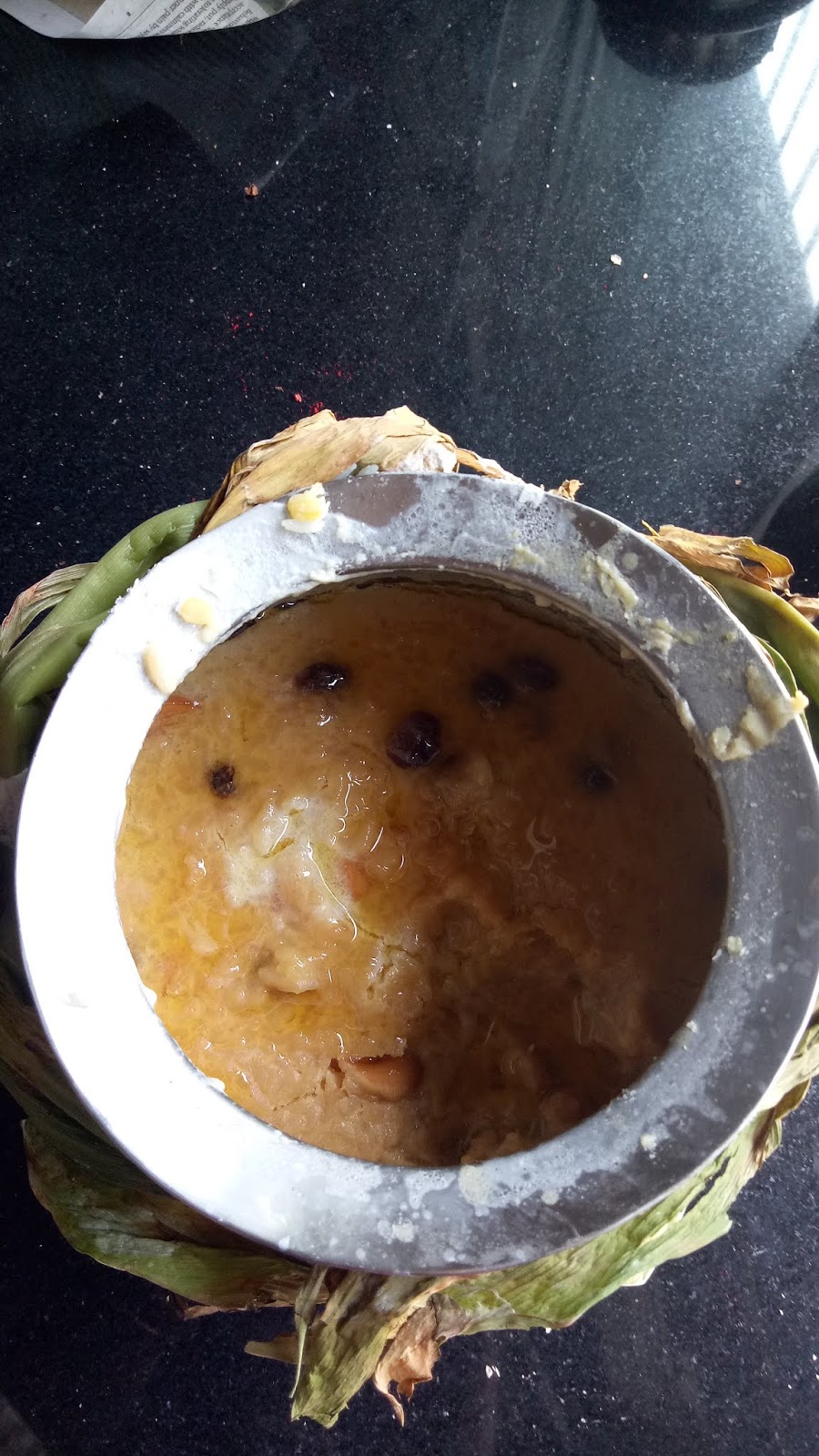
Take a pan and melt the jaggery in 2 cups of water. Filter to remove dirt or impurities. Add the fine small sliced coconut pieces, the Karamani and boil. When the jaggery water starts boiling, add a teaspoon of ghee. the cardomom powder and then the roasted rice powder while stirring continuously till the mixture leaves the sides of the pan. Off the burner and allow it to cool.
Roll the mixture into balls, flatten them and make holes in the middle as shown in the picture. Now steam the sweet karadais in an idli cooker for 15 minutes.
Your sweet Karadai is ready to serve with butter.

The recipe for Salted Karadai


Ingredients
Dry roasted rice powder
Salt to taste
Karamani - 1 or 2 tablespoons
Coconut slices

Seasoning
Oil - 1 tablespoon
Mustard - 1/2 teaspoon
Udad dal - 1/4 teaspoon
Curry leaves - a few
Green chilli - 1 or 2 finely chopped
Ginger - a small piece finely chopped.
Asefoetida - a pinch

Method of Preparation

Prepare the rice powder and cook the karamani in the same way as for the sweet Karadai
Heat the oil in a saucepan and add mustard. Let it sputter. Add udad dal, asefoetida, and chopped ginger and green chillies. Then add the curry leaves. Now add the coconut finely sliced and karamani. Add water and salt to taste. Bring it to a boil. When the water starts boiling, lower the flame and add the rice powder slowly and stir continuously till the mixture leaves the sides of the pan. Allow it to cool. Then like the sweet Karadai, divide it into balls, flatten them and carve a hole in the middle of each. Steam these salted adais in an idli cooker or steamer and your salted karadais are ready to serve.

#KaradayanNombu #festival #SweetKaradai #SaltedKaradai #recipe #TamilNadu #SavitriVrat, #Nolumbu #Savitri #Satyavan

Wednesday, February 19, 2020

The Magnificent #Temple to Lord #Shiva at #Rameshwaram in #TamilNadu #templestories 5


Since ages, a journey to the temple city of Rameshwaram has been the starting point and culmination of the holy Kashi Yatra. Hindus believe that their life is incomplete without undertaking this Kashi-Rameshwaram Yatra at least once in a lifetime. We have done the yatra twice, but this time we went to Rameshwaram as part of our pilgrimage to some important temples in Tamil Nadu. We touched down at Madurai airport at around 11 am and proceeded directly to Rameshwaram in a cab. The four hour long drive via Ramanathapuram, to cover the distance of approximately 174 km. was made easy by the well maintained roads, except for a small patch where road widening work was in progress. We breezed through villages with intriguing names like Thangachimadam (home of younger sister) and Akkamadam (home of elder sister) and reached the Pamban Bridge, which connects the conch shaped island of Rameshwaram to mainland India. The beautiful sight of the bridge across the expansive blue waters of the sea drew our breath away, and we could not but stop to get down, savour the magnificent view and take photographs.
A view of the Pamban Railway bridge


Panoramic view of Pamban Island


On reaching the temple town, we were impatient to visit the magnificent Ramanathaswami temple, but the vadhyar (priest) advised us to visit the temple in the morning, after taking bath in the holy Agnitheertham and the 22 theerthams in the famous third prakaram of the temple. He also advised us to take a change of clothing as entrance into the main temple sanctum is not allowed in wet clothes.
Agnitheertham

At dawn, we were ready to take a dip in the Agnitheertham. The magical allure of the deep blue sea beckoned us to step into the clean shallow water and immerse ourselves. The taste of salt on our lips and the light burning sensation in our eyes reminded us that this holy water is not called Agnitheertham for nothing. An old man, who was taking a bath alongside, told us that Hanuman had dipped his burning tail in the sea after the epic Lankadahan and hence the burning sensation in our eyes. I don’t know how far this is true, but it seemed to be a logical explanation, and one which I had not heard of before. However, I have read somewhere that Lord Rama took a bath in the Agnitheertham to absolve himself of the sin of killing Ravana, who was a learned Brahmin. 
We then walked towards the temple in our wet attire which dried by the time we reached the temple premises. The priest had arranged for a guide, who bought the tickets and led us to the 22 theerthams in the prescribed chronological order starting with the Mahalakshmi theertam and ending with the Koditheertham. The guide was mentioning about the significance of each theertham but in the noise and crowd, I could fathom only a few. The Koditheertham is where the Lord Sri Krishna was redeemed of the sin of killing his uncle Kamsa.
Devotees doused in water walking along the corridor from one Theertham to another

We gave ourselves up to the pure joy of being doused with buckets of water from the theerthams one by one, which culminated in the Kodi theertham inside the temple. The water of the theerthams varies in taste, some sweet, some salty, some cold, some warm.  This is an exhilarating experience, definitely not to be missed by anyone who visits Rameshwaram. Apart from the 22 theerthams inside the temple, we heard that there are supposedly 31 theerthams in the vicinity of Rameshwaram, Navabhashanam in Ramanad and Dhanushkodi. Some of these are well maintained, whereas others are neglected.  
A view of the Gopuram from the corridor

The temple itself is a massive structure with a majestic gopuram, three prakarams or enclosures and a magnificent corridor believed to be the longest temple corridor in India. The visual impact of this famous third prakaram is extraordinary, appearing as though the pillars are progressively shorter and thicker, gently receding into the darkness.
The magnificent third prakaram

The Ramanathaswami temple is believed to be as old as the Ramayana. Legend goes that Rama was returning from Lanka with a heavy heart as he had vanquished Ravana, who was a great Shiva bhakt. To atone for this sin, he wanted to worship Lord Shiva. He requested Hanuman to bring a Shivaling from Kailas. But when the auspicious time arrived, there was no sign of Hanuman. So Sita made a Shivaling of sand from the seashore. As Rama was completing his worship of the Lord, Hanuman arrived with a Shivaling. Seeing the disappointment and sorrow on Hanuman’s face, Rama instructed that the Shivaling brought by Hanuman would be worshipped first. The Shivaling made by Sita is called Ramalingam or Ramanathaswami, the Lord of Rama. The Shivaling brought by Hanuman is called Vishwalingam, the Lord of the world. The practice of worshiping the Vishwalingam before Ramalingam is still followed.
Another story, again connected to Ramayana, says that Rama and his monkey army were trying to build the sethu (bridge) across the sea but failed every time, as the bridge they would construct during the day would be destroyed by Ravana and his men during the night. It was then that Rama was advised to worship a Shivalingam in the midst of the sea, as it was felt that Ravana being a staunch devotee of Lord Shiva, he would not destroy a Shivaling. This is believed to have worked and Rama could build the sethu without any further hindrance. 
I have also heard of an interesting folk tale about Rama searching for a learned Brahmin to perform a yagna to worship Lord Shiva, but could not find one. Vibhishana, the younger brother of Ravana, suggested that Rama send a message to Ravana as he was a learned Brahmin. It is said that Rama sent an invitation to Ravana and he not only accepted, but knowing that Rama could not perform the yagna without his wife, Ravana brought Sita Mata also along with him. After the yagna was performed when Rama and Sita sought his blessings, Ravana blessed Rama to be victorious and Sita to have a long married life. I don't know whether this is true or not, though.
As we enter the main sanctum we find a huge Nandi over 15 ft. in height, in a grilled enclosure. Ramalingam, made by Sita, is worshipped in the main sanctum as Ramanathaswami. To the left, there is a separate shrine to Parvathavardini, the consort of Ramanathaswami. The sanctum to Vishwalingam, brought by Hanuman, is to the right. Worship to Vishwanathaswami is offered first. There is a shrine to Goddess Vishalakshi also. Behind the main sanctum there is a shrine to Lord Vishnu as Sethu Madhava, the God of the Sethupatis, who ruled here. He is also considered the guardian of the Sethu. There is a separate shrine to Nataraja or the dancing Shiva, decorated with rudrakshams and surrounded by offerings of Naga images.
It is said that only a structure with a thatched roof existed over the sanctum for a long time until the 12th century. Most of the pillars and designed structures were built by the Sethupati rulers of Ramanathapuram between the 12th and 16th centuries. The world famous third prakaram was built as recently as the 18th century by Muthuramalinga Sethupati.  
Inscription describing the dimensions of the third prakaram built by Muthuramalinga Setupathi

We heard that renovation of the inner prakarams took place in the 20th century and further work may be undertaken to finish construction of the unfinished North and South towers or gopurams.
The importance of the temple is enhanced by the fact that the shrine of Ramanathaswami is one of the 12 sacred Jyothirlingas. Apart from the usual special darshan and abhishek, we were fortunate to have a darshan of the Spatikalingam pooja conducted only early in the morning. Our minds purified and our souls satiated, we reluctantly left the temple premises, promising ourselves to make a visit again whenever possible.
Some important information: The temple is open from 5.00am to 1.00pm and 3.30pm to 9.00pm. The Spatikalingam pooja is held at 5.00 am daily. Special entry tickets of Rs. 50/- per person, are available for all the other poojas. There is a token fee for Ganga jal abhishekam, which is very important for people who are coming to Rameshwaram as a part of the Kashi Yatra. Ganga jal is also available at the temple for a charge of Rs. 50/- per litre. If you happen to visit on a Friday, you can see the procession of the Goddess Parvathavardini in a golden palanquin at around 7.00 pm.
The most important festivals are Shivaratri (Feb-March), the Thirukalyanam or wedding celebration of Lord Ramanathaswami with Goddess Parvathavardini in (July-August).
#Rameshwaram #Temple #Shivaratri #LordShiva #RameshwaramTemple #RameshwarKashiYatra, #GoddessParvatavardhini #worldfamous  #Ramanathaswami

Tuesday, February 11, 2020

A Visit to #TirupatiBalaji #Temple as a Senior Citizen #Temple Stories 4


Our annual pilgrimage to Tirupati just became easier because we are now senior citizens. The Tirupati Tirumala Devasthanam (TTD) provides a stress free darshan to seniors above the age of 65 years. We are totally impressed, considering the heavy crowds and the otherwise long waits in queue.

Tirupati, located in Chitoor district of Andhra Pradesh, is home to the Tirupati Balaji temple, one of the most sacred shrines in the world. The temple is nestled atop the seventh hill in Tirumala and can be reached either on foot by climbing steps or by a vehicle on a well maintained road. As we approach Tirumala, we see a huge statue of Garuda, the divine Vahan of Lord Balaji.  
The Statue of Garuda at the foothills of Tirumala

The Tirumala Checkpost


We proceed to the Tirumala checkpost, where we are asked to step down from the vehicle and undergo stringent security check. The car is also scrutinized thoroughly. As we are driven through the Hills, (there are seven of them), a cool breeze caresses our cheeks as we take in the magnificent view. The driver is communicative and points out the spot where the distant view of the hills appear shaped like an elephant and another spot where a stone cliff jutting out from the mountain resembles the face of Balaji. These are natural stone formations and you will notice them only if someone points it out to you.

The sight of beautifully coloured flower gardens heralds the fact that we have almost reached the temple. The driver takes us right up to the gate where the counter for physically disabled and senior citizen passes are issued is located. We join the queue at around 6.30 am and wait till exactly around 7.30 am, when the counter opens. The queue is unimaginably orderly and there is no way that anyone can bypass anyone in the queue. Considering that this is a line for senior citizens, seating arrangements are there. The digital format and display, whereby the coupons are issued gives one an idea as to where we stand as far as the availability is concerned. Exactly 700 passes are issued for the 10.00 am darshan and 700 passes for the darshan at 3.00 pm. One has to show the age identity proof (Aadhar Card) and undergo a biometric photo identity process by the authorities before they issue the pass. Each senior citizen is allowed to take his/her spouse along and the biometric identity is taken for both.  A handicapped person can take one person along for help. Darshan by the senior citizen line is restricted to once in three months, which means that once you have availed of darshan, you cannot avail of this facility for three months ahead.  This is to ensure that maximum number of senior citizens can avail of this facility.

We get our passes and are directed to a queue outside. A mini bus or a battery car takes us to the rooms where you can sit comfortably. The volunteers give us a glass of milk to drink. After a few minutes they offer us a plate of Venn Pongal as breakfast (The breakfast differs on different days. It could be Venn Pongal/Kichadi/Upma). This is to see that the seniors are not hungry when they see the Lord. Exactly at 10.00 am the rooms are opened one by one and we are led to the main shrine for darshan. Again there is security check of handbags or purses. Though the actual darshan is just for a few seconds, the raised sloping pathway to the shrine ensures that everyone has a good darshan. After that, there is a queue for the free prasad, where we are offered a donnai of puliogarai.

After the wonderful darshan, there is a battery car which will take handicapped and super senior citizens up to the exit gate, though we did not avail of the facility as there were quite a few handicapped devotees who required the facility more than us.         
Fully satiated with the divine darshan of Tirupati Balaji, we drove back. The road to drive back is different from the one we take for going up, making it easier to maneuver the sharp U turns. A deer park comes into view, where we can see a lot of deer grazing on the grass. On the way we stop to pray to a huge statue of Hanuman and then head back to our hotel.
Shrine to Sri Hanuman


Points to Note:
1.       Security is absolutely stringent. Mobiles are strictly not allowed.
2.       Make it a point to carry your identity proof, preferably Aadhar Card, if you are availing the Senior Citizen facility.
3.       Reach the queue at least one hour in advance of the counter opening time to ensure that you get entry.
4.       The morning darshan for senior citizens is not available on Wednesday and Friday. 

##Tirupati  #Tirumala #TirupatiBalaji #SeniorCitizenDarshan #TTD  #temple #AndhraPradeshTourism  #SriVenkateshwara #IdentityProof

Monday, January 13, 2020

#Pongal celebrations in Tamil Nadu #Festival 5


We, South Indians, await our main festival Pongal with great glee in the month of January, as this is the time we get to interact with family, cousins and extended family members. This year, Pongal celebrations fall between 14th to 17th January, it is the time we reverently worship the forces of nature like the Sun and the rain and thank them for giving us a plentiful harvest. 
Lord Indra gives us adequate rain. Dedicated to Lord Indra, the first day of Bhogi pongal, as this tradition is called, is full of joy and merriment. It is fascinating to watch young girls dance around a bonfire kept burning with mud, wood and cowdung. 

Prayers are offered to the Sun God on the second day marking the main festival of Pongal. On this day we create beautiful rangolis with rice flour in front of the house and wear new traditional clothes. We wait for the auspicious time, to tie a turmeric plant around a curved pot and decorate it with haldi kumkum. Milk is allowed to boil and overflow in this vessel symbolically for prosperity and well being to overflow in the family. A delicious sweet porridge of milk, rice, dhal and sugar is prepared as offering for the Sun God along with sugarcane, and the mandatory betel leaves, betel nuts, coconut and yellow bananas.  
Mattu Pongal follows on the third day when prayers are offered to the cows which help the farmers in so many ways. Everywhere in Tamil Nadu, we can see colorful sights of cows decorated with garlands and tilak wearing a string of colourful beads and bells around the cow’s neck. Puja and arati is performed. The famous Jalli kattu or bull fight is also organized in villages. Kannum Pongal is a traditional feature on the final day, when a turmeric leaf is washed and kept in the open courtyard on which rice, betel leaves, nuts, turmeric, coconut etc. are placed. In some places, arati is performed for the brothers by the sisters, who pray for the prosperity of their families.
As we all know no festival is complete without food delicacies and Pongal is no exception. The Sakkarai Pongal and the Venn Pongal are symbolic of the festival, simple and delicious, yet highly nutritious too.
Here are the recipes for you to prepare and enjoy.
Sakkarai Pongal

Ingredients:
Raw Rice – 1 cup
Yellow Moong Dhal – 1/4 cup
Milk – 1 litre
Jaggery – 2 cups (grated)
Cashews – 3 tablespoons
Raisins – 3 tablespoons
Powdered Cardamom – ½ teaspoon
Ghee – 3 tablespoons


Method:
Roast the moong dhal in a teaspoon of ghee till it slightly changes color. Remove on to a bowl and soak it along with raw rice in water for 10 minutes. Strain it to remove water.
Take a vessel and boil milk. Add  the soaked and strained rice and dhal to the milk and cook on low flame till the rice is cooked. Mash it up with a spoon and keep aside.
Add the jaggery to water and bring to a boil. Strain to remove impurities. Add this jaggery water to the milk, rice and dhal mixture. Stir well on a low flame till they are completely mixed.
Take a pan and pour the rest of the ghee in it. Fry Cashews and raisins in the ghee to a golden brown and add the pongal mixture. Stir on low flame till they blend well. Add cardamom powder and mix.
Your Sakkarai Pongal is ready to serve.
Venn Pongal

Ingredients


Yellow Moong Dhal – 1/2  cup
Raw Rice -  3/4 cup
Ghee – ¼ cup
Cashew nuts – 2 tablespoons
Ginger sliced or minced – ½ teaspoon (optional)
Green chilly chopped -1 (optional)
Cumin seeds – 1 teaspoon
Black pepper – 1 teaspoon
Curry leaves - 1 sprig
Salt to taste
Method
Roast the moong dhal in a teaspoon of ghee till it slightly changes color and gives off a lovely smell. Remove on to a bowl and soak it along with raw rice in water for 10 minutes. Cook the dhal and rice together in a pressure cooker with 3 ½ cups of water for 6 to 7 whistles. Grind the pepper and cumin to a coarse powder after dry roasting.
 Heat the ghee in a pan. Fry the broken cashew nuts to a golden brown. Add ginger, curry leaves and green chilly (optional). Roast on a low flame. Add in the pepper-cumin mixture and roast for a few seconds. Pour the cooked rice-dhal mixture and add salt to taste. Stir till the entire mixture blends well.
Your Venn Pongal is ready to serve.

#Pongal #SarkaraiPongal #VennPongal #Recipe #BhogiPandigai #MattuPongal #Jallikattu


Thursday, January 9, 2020

#Thiruvadhira #festival celebrations in Kerala and Tamil Nadu #Festival 4


On the occasion of Thiruvadhira festival on 30th December  2020, I wish to share an excerpt from my book 'Kerala the Divine Destination'


Thiruvadhira is celebrated as the birthday of Lord Shiva as thiruvadhira is known as the nakshatra (star) of Lord Shiva. There is also a belief that this was the day when Kamdev was reduced to ashes by the opening of the third eye of Lord Shiva and a solution was found for his resurrection. This is believed to be the day that Lord Shiva accepted Goddess Parvathi as his consort after her long penance. Thiruvadhira in Kerala is celebrated in a grand manner in all Shiva temples in Kerala and it corresponds to the Ardhara Darshanam of Tamil Nadu, which is celebrated on a very grand scale as an annual utsavam in Chidambaram.

The legend behind the festival is very interesting. Lord Shiva was the only one amongst all the Devas who was not invited by Dakshan, the father of Goddess Sati, for the Maha Yagna which he was performing. However, though the Lord warned her about the consequences of being an uninvited guest albeit at her father’s house, Sati went for the Yagna. She was ignored and forced to hear her husband insulted by her father, upon which she immolated herself in the sacrificial fire. She was reborn as Goddess Parvathy, the daughter of Himavan and Myenadevi, and did penance for a long time for securing Lord Shiva as her husband. Meanwhile, an Asura named Tarakasur, acquired the boon of not meeting death at the hands of anyone except the combined power of Shiva and Shakti. The Lord was in meditation and nobody had the courage to disturb Him, but the Devas unable to bear the torture of Tarakasur instructed Kamdev to lure Lord Shiva with his cupid’s arrow to Goddess Parvathy who was doing penance and serving the Lord. Shiva was furious at being disturbed and opened his third eye to reduce Kamdev to ashes. Being pleased with her long penance, and recognizing his beloved Sati in this new Avatar, He accepted Parvathy as his consort. Rati, the wife of Kamdev wept at Lord Shiva’s feet, and being persuaded by Goddess Parvathy gave the solution for the resurrection of Kamdev as Lord Krishna’s son. An important part of the festival is the 'Ettangadi chuduka' , during which, eight different tubers are roasted in the fire. It is believed that Kamadeva's body is represented by the tubers and by this ritual, his body is resurrected.Thiruvadira being the day that Lord Shiva accepted Parvathi as his consort, the festival is more woman centric as women from the traditional Malayali families fast for the well being of their husbands and marital bliss, whereas unmarried women undertake the fast to get a good husband.

The day starts early in the morning with a visit and prayers to the nearest Shiva temple before sunrise in traditional attire.The women then prepare the Kanzhi – puzhukku for the meal. The Kanzhi is made of broken wheat. The Thiruvadira puzhukku is a delicious concoction of chembu (colocasia), chenai (yam), koorkai (chinese potato), Madhurakizhangu (Sweet potato) , all tubers, with payaru (red cow beans) and kaaya (raw banana).They are cooked with salt and freshly ground coconut. Another speciality of the Thiruvadira meal is the koova payasam, a sweet dish made of arrow root powder, jaggery and coconut milk. Even the women who are fasting can have these items as they do not contain rice and fasting during Thiruvadhira means abstaining from consumption of rice for the Malayali women. In Palakkad, the same pattern of early morning visit to the Shiva temple is followed. However their meal consists of Kali and Kootu.


The women gather for the song and dance routine, so typical of the festival, on the day prior to Thiruvadhira on the Makeeram star, which lasts through the night. A big brass lamp (nelavilakku) is placed in the middle and the women form a circle around it. They start dancing with swaying movements and clapping of hands to the rhythm of the song that is first sung by the leader and repeated by the group members. They start with the invocation of Ganapathy and Goddess Saraswathy. The Thiruvathira pattu (songs) are simple yet full of meaning. Their lyrics are about Parvathi’s love and longing for Shiva, her penance and the description Shiva’s power and divinity. The dance of Kaikottikali has been performed during Thiruvadira for ages and the hand movements and dance gestures are common to the region.The dress for the dancers is very traditional. It consists of two pieces, a cream coloured dhoti (mundu) and an upper garment (neriyathu) of the same colour. Generally there is a gold coloured border for both the garments.

At midnight there is a ceremony called pathira poochoodal, when the women will adorn the dasapushpam (10 important medicinal flowers) on their hair with utmost devotion. The pathirapoochoodal ceremony for a newly wedded bride is even more special and is called poothiruvadhira. The dance then continues until the wee hours of dawn. In the midst of all the ritual there is a unique ritual of consuming 108 betel leaves with scented arecanuts by the women. These leaves are first offered to Lord Shiva and then taken and chewed.


#Thiruvadhira #Festival #Kerala #TamilNadu #Chidambaram #Kaikottikali #LordShiva