Monday, January 13, 2020

#Pongal celebrations in Tamil Nadu #Festival 5


We, South Indians, await our main festival Pongal with great glee in the month of January, as this is the time we get to interact with family, cousins and extended family members. This year, Pongal celebrations fall between 14th to 17th January, it is the time we reverently worship the forces of nature like the Sun and the rain and thank them for giving us a plentiful harvest. 
Lord Indra gives us adequate rain. Dedicated to Lord Indra, the first day of Bhogi pongal, as this tradition is called, is full of joy and merriment. It is fascinating to watch young girls dance around a bonfire kept burning with mud, wood and cowdung. 

Prayers are offered to the Sun God on the second day marking the main festival of Pongal. On this day we create beautiful rangolis with rice flour in front of the house and wear new traditional clothes. We wait for the auspicious time, to tie a turmeric plant around a curved pot and decorate it with haldi kumkum. Milk is allowed to boil and overflow in this vessel symbolically for prosperity and well being to overflow in the family. A delicious sweet porridge of milk, rice, dhal and sugar is prepared as offering for the Sun God along with sugarcane, and the mandatory betel leaves, betel nuts, coconut and yellow bananas.  
Mattu Pongal follows on the third day when prayers are offered to the cows which help the farmers in so many ways. Everywhere in Tamil Nadu, we can see colorful sights of cows decorated with garlands and tilak wearing a string of colourful beads and bells around the cow’s neck. Puja and arati is performed. The famous Jalli kattu or bull fight is also organized in villages. Kannum Pongal is a traditional feature on the final day, when a turmeric leaf is washed and kept in the open courtyard on which rice, betel leaves, nuts, turmeric, coconut etc. are placed. In some places, arati is performed for the brothers by the sisters, who pray for the prosperity of their families.
As we all know no festival is complete without food delicacies and Pongal is no exception. The Sakkarai Pongal and the Venn Pongal are symbolic of the festival, simple and delicious, yet highly nutritious too.
Here are the recipes for you to prepare and enjoy.
Sakkarai Pongal
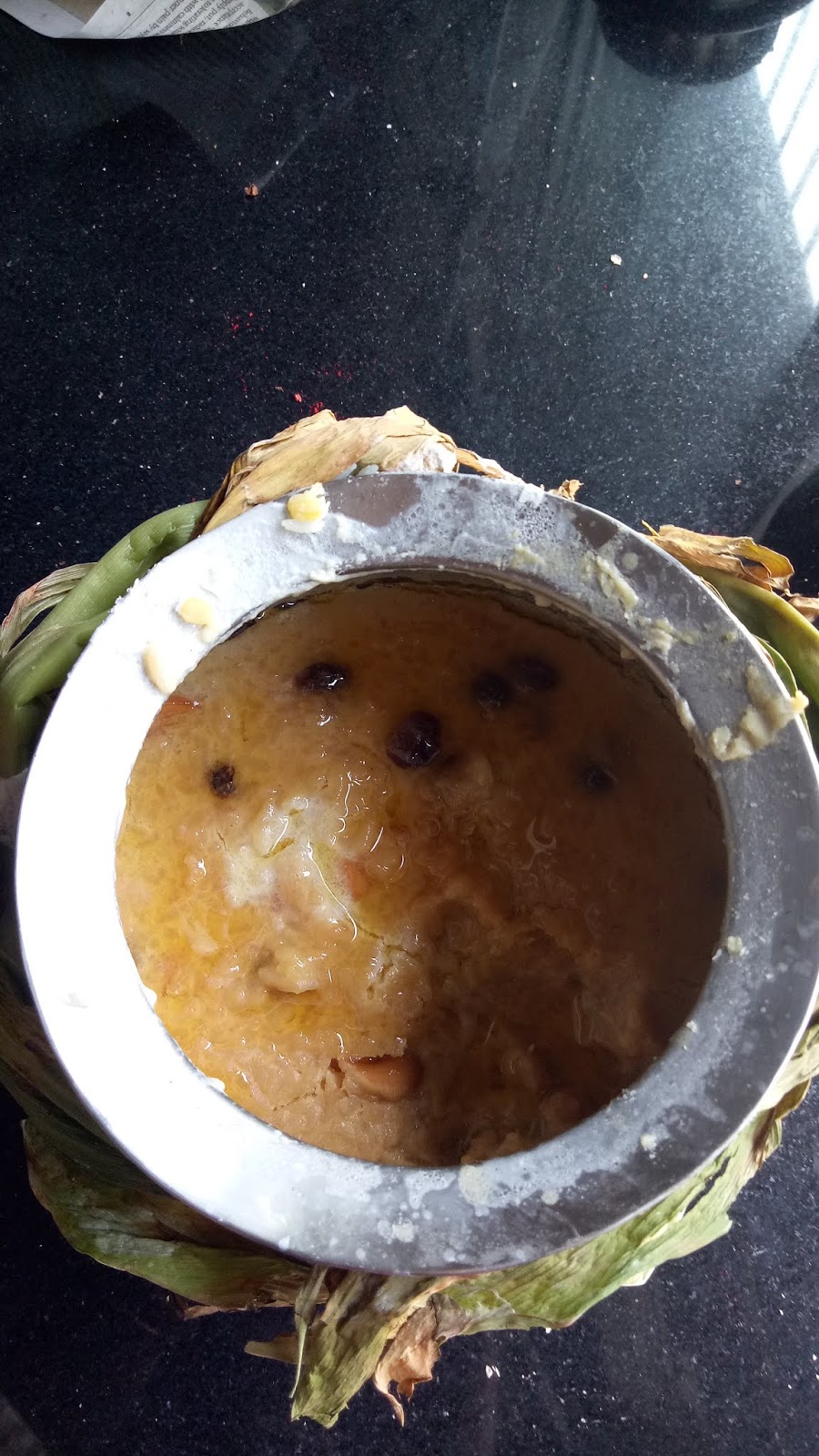
Ingredients:
Raw Rice – 1 cup
Yellow Moong Dhal – 1/4 cup
Milk – 1 litre
Jaggery – 2 cups (grated)
Cashews – 3 tablespoons
Raisins – 3 tablespoons
Powdered Cardamom – ½ teaspoon
Ghee – 3 tablespoons


Method:
Roast the moong dhal in a teaspoon of ghee till it slightly changes color. Remove on to a bowl and soak it along with raw rice in water for 10 minutes. Strain it to remove water.
Take a vessel and boil milk. Add  the soaked and strained rice and dhal to the milk and cook on low flame till the rice is cooked. Mash it up with a spoon and keep aside.
Add the jaggery to water and bring to a boil. Strain to remove impurities. Add this jaggery water to the milk, rice and dhal mixture. Stir well on a low flame till they are completely mixed.
Take a pan and pour the rest of the ghee in it. Fry Cashews and raisins in the ghee to a golden brown and add the pongal mixture. Stir on low flame till they blend well. Add cardamom powder and mix.
Your Sakkarai Pongal is ready to serve.
Venn Pongal

Ingredients


Yellow Moong Dhal – 1/2  cup
Raw Rice -  3/4 cup
Ghee – ¼ cup
Cashew nuts – 2 tablespoons
Ginger sliced or minced – ½ teaspoon (optional)
Green chilly chopped -1 (optional)
Cumin seeds – 1 teaspoon
Black pepper – 1 teaspoon
Curry leaves - 1 sprig
Salt to taste
Method
Roast the moong dhal in a teaspoon of ghee till it slightly changes color and gives off a lovely smell. Remove on to a bowl and soak it along with raw rice in water for 10 minutes. Cook the dhal and rice together in a pressure cooker with 3 ½ cups of water for 6 to 7 whistles. Grind the pepper and cumin to a coarse powder after dry roasting.
 Heat the ghee in a pan. Fry the broken cashew nuts to a golden brown. Add ginger, curry leaves and green chilly (optional). Roast on a low flame. Add in the pepper-cumin mixture and roast for a few seconds. Pour the cooked rice-dhal mixture and add salt to taste. Stir till the entire mixture blends well.
Your Venn Pongal is ready to serve.

#Pongal #SarkaraiPongal #VennPongal #Recipe #BhogiPandigai #MattuPongal #Jallikattu


Thursday, January 9, 2020

#Thiruvadhira #festival celebrations in Kerala and Tamil Nadu #Festival 4


On the occasion of Thiruvadhira festival on 30th December  2020, I wish to share an excerpt from my book 'Kerala the Divine Destination'


Thiruvadhira is celebrated as the birthday of Lord Shiva as thiruvadhira is known as the nakshatra (star) of Lord Shiva. There is also a belief that this was the day when Kamdev was reduced to ashes by the opening of the third eye of Lord Shiva and a solution was found for his resurrection. This is believed to be the day that Lord Shiva accepted Goddess Parvathi as his consort after her long penance. Thiruvadhira in Kerala is celebrated in a grand manner in all Shiva temples in Kerala and it corresponds to the Ardhara Darshanam of Tamil Nadu, which is celebrated on a very grand scale as an annual utsavam in Chidambaram.

The legend behind the festival is very interesting. Lord Shiva was the only one amongst all the Devas who was not invited by Dakshan, the father of Goddess Sati, for the Maha Yagna which he was performing. However, though the Lord warned her about the consequences of being an uninvited guest albeit at her father’s house, Sati went for the Yagna. She was ignored and forced to hear her husband insulted by her father, upon which she immolated herself in the sacrificial fire. She was reborn as Goddess Parvathy, the daughter of Himavan and Myenadevi, and did penance for a long time for securing Lord Shiva as her husband. Meanwhile, an Asura named Tarakasur, acquired the boon of not meeting death at the hands of anyone except the combined power of Shiva and Shakti. The Lord was in meditation and nobody had the courage to disturb Him, but the Devas unable to bear the torture of Tarakasur instructed Kamdev to lure Lord Shiva with his cupid’s arrow to Goddess Parvathy who was doing penance and serving the Lord. Shiva was furious at being disturbed and opened his third eye to reduce Kamdev to ashes. Being pleased with her long penance, and recognizing his beloved Sati in this new Avatar, He accepted Parvathy as his consort. Rati, the wife of Kamdev wept at Lord Shiva’s feet, and being persuaded by Goddess Parvathy gave the solution for the resurrection of Kamdev as Lord Krishna’s son. An important part of the festival is the 'Ettangadi chuduka' , during which, eight different tubers are roasted in the fire. It is believed that Kamadeva's body is represented by the tubers and by this ritual, his body is resurrected.Thiruvadira being the day that Lord Shiva accepted Parvathi as his consort, the festival is more woman centric as women from the traditional Malayali families fast for the well being of their husbands and marital bliss, whereas unmarried women undertake the fast to get a good husband.

The day starts early in the morning with a visit and prayers to the nearest Shiva temple before sunrise in traditional attire.The women then prepare the Kanzhi – puzhukku for the meal. The Kanzhi is made of broken wheat. The Thiruvadira puzhukku is a delicious concoction of chembu (colocasia), chenai (yam), koorkai (chinese potato), Madhurakizhangu (Sweet potato) , all tubers, with payaru (red cow beans) and kaaya (raw banana).They are cooked with salt and freshly ground coconut. Another speciality of the Thiruvadira meal is the koova payasam, a sweet dish made of arrow root powder, jaggery and coconut milk. Even the women who are fasting can have these items as they do not contain rice and fasting during Thiruvadhira means abstaining from consumption of rice for the Malayali women. In Palakkad, the same pattern of early morning visit to the Shiva temple is followed. However their meal consists of Kali and Kootu.


The women gather for the song and dance routine, so typical of the festival, on the day prior to Thiruvadhira on the Makeeram star, which lasts through the night. A big brass lamp (nelavilakku) is placed in the middle and the women form a circle around it. They start dancing with swaying movements and clapping of hands to the rhythm of the song that is first sung by the leader and repeated by the group members. They start with the invocation of Ganapathy and Goddess Saraswathy. The Thiruvathira pattu (songs) are simple yet full of meaning. Their lyrics are about Parvathi’s love and longing for Shiva, her penance and the description Shiva’s power and divinity. The dance of Kaikottikali has been performed during Thiruvadira for ages and the hand movements and dance gestures are common to the region.The dress for the dancers is very traditional. It consists of two pieces, a cream coloured dhoti (mundu) and an upper garment (neriyathu) of the same colour. Generally there is a gold coloured border for both the garments.

At midnight there is a ceremony called pathira poochoodal, when the women will adorn the dasapushpam (10 important medicinal flowers) on their hair with utmost devotion. The pathirapoochoodal ceremony for a newly wedded bride is even more special and is called poothiruvadhira. The dance then continues until the wee hours of dawn. In the midst of all the ritual there is a unique ritual of consuming 108 betel leaves with scented arecanuts by the women. These leaves are first offered to Lord Shiva and then taken and chewed.


#Thiruvadhira #Festival #Kerala #TamilNadu #Chidambaram #Kaikottikali #LordShiva

Monday, December 9, 2019

Come December and its Margazhi Music Season in Chennai


The advent of December heralds the grand and oldest music festival season in Asia, the Margazhi Carnatic Music season in Chennai. Music lovers are in for a treat. They make a beeline for the various venues waiting to be entranced by well known musicians who present their brilliant repertoire. I am in Chennai for five days and I want to make the most of it. My feet drag me to the venue of the inauguration of the music season at Brahma Gana Sabha by the Governer of Tamil Nadu. The function was to be followed by a concert by the tremendously talented vocalist, Abhishek Raghuram. For the uninitiated, Abhishek is the grandson of the legendary Mridangam artist, Palghat Raghu and has a connection with the violin maestro, Lalgudi S. Jayaraman on his maternal side. With these genes, it is not at all surprising that Abhishek is one the most talented musicians of the present generation. As usual, the audience was treated to some majestic ragam alapanai and breathtaking kalpana swaras.  His rendering of the ‘Bhavayami Raghuramam’ was the cream on the cake, to be relished and cherished by the music fans. I had another reason for making it to the Brahma Gana Sabha inauguration ceremony. They release their booklet which contains relevant details of all concerts held by the various Sabhas for the entire season. This makes it easy for a visitor with a short span of time at their disposal to pick and choose the concerts by the artists of their choice.
The ready reckoner for Chennai Music Season 


The second day, I chose to go to Kamarajar Arangam, where Sheshank was to give a flute recital. The concert was really good but I was astonished by the sparse audience that would not have numbered more than a couple of hundreds in a hall that has a capacity of more than a thousand.
Sheshank on Flute
The genius of Sheshank’s music saved the day, though it set me wondering about the lack of interest displayed by the younger generation in Carnatic music. But that illusion was partially set right, when I attended the concert of the Kunnakudi Balamuralikrishna the next day.

Kunnakudi Balamuralikrishna

 Though the audience was predominantly of the older generation, there were some youngsters in the audience giving their undivided attention to the exquisite nuances, great voice range and purity of music displayed by the young artist. 
The concert by Sid Sriram on the following day had maximum youngsters in the audience probably because he is a well known musician in movie circles too.    
The fifth day was a veritable musical treat. I had the occasion to hear both Vishaka Hari’s stunning musical discourse as well as Abhishek Raghuram’s brilliant concert, both at the same venue one after the other organized by Kartik Fine Arts.
Vishaka Hari's mesmerising discourse

Vishaka Hari’s mellifluous voice and her ability to engage the audience is well known. Her topic for the day was on the ‘Panchabootha Sthalas’ and her rendering was a wonderful experience. Abhishek Raghuram is exceptional. No other word can describe his brilliance. His research, the way he improvises, the range, the voice and the mastery over the ragas all make him a favourite with the audience, who, time and again, give him a standing ovation. This made my day. 
Abhishek Raghuram in concert

My disappointment with the audience on the second day was more than made up for by the almost houseful audience for Vishaka Hari and Abhishek Raghuram.
Having had the opportunity to personally experience the thrill of the Margazhi Music Season, albeit for a very short span, I leave Chennai with reluctance as there is so much more in store for music connoisseurs. But I am happy that the platform provided by Margazhi music season for Carnatic music is not getting trapped in stagnation and still going strong, thanks to the young and exceptionally talented artists.
   
#Music #CarnaticMusic #Margazhi #musicseason #Chennai #AbhishekRaghuram, #KunnakudiBalamuralikrishna #SidSriram #VishakaHari #Sheshank

Saturday, September 28, 2019

5 States in India Celebrate #Navaratri in 5 different ways #Festival 3


Are the strains of music wafting in the air? Are you waiting to dazzle the gathering with colourful costumes?
Yes. Navaratri, the annual festival, an eclectic mix of religious fervor and enjoyment is here again. The brilliant colours of rangoli, the traditional costumes, rhythmic clap of dandiya sticks, the artistic doll displays, the delectable bhog offerings and the devotion of the devotees mark this beautiful nine day festival. Navaratri is synonymous with the worship of the nine forms of Maa Durga, namely Shailaputri, Brahmacharini, Chandraghanta, Kushmanda, Skandamata, Katyayani, Kalaratri,  Mahagauri, and Siddhidatri.  The festival culminates on the tenth day of Vijaya Dashami. 
Want to know how the festival is celebrated in different ways under different names in different parts of India? Read on.


The world famous Durga Puja, the main festival of the year in Kolkota comes to mind as soon as you think of Navaratri. Bengalis come out bedecked in their glorious red saris and finest jewellery to participate in their puja pandals. However, the puja is not confined to Kolkota alone. It is celebrated throughout the eastern States of West Bengal, Assam, Odisha and Bihar, though the celebrations in Kolkota is akin to the Ganesh Utsav celebrations of Mumbai or Pune. Large sized idols of Goddess Durga on her vahan, the lion, with her trident aimed at the dreaded demon Mahishasur are installed in beautifully decorated pandals to the beats of dhol, dhak and dhunuchi naach, and the celebrations are open to the public on the last four days of Navaratri  (Saptami, Ashtami, Navami and Dashami.)There are some unique rituals associated with the Durga Puja. The idols are sculpted and made ready before Navaratri begins, but the eyes are not painted till Mahalaya. This is the day that the Goddess is invited on earth and the eyes are drawn on this day in an auspicious ritual called Chokku Daan, in the belief that the Goddess will descend to earth to give her blessings to her devotees. And the bhog offered to Maa Durga includes sweets like naru, kheer, payesh, malpua, patishapta, chandrapuli and goja. Interestingly I have not seen rosogolla (my favourite sweet) being offered to the Goddess or am I mistaken?


We mention Navaratri in Gujarat and what does one visualise! The eruption of colours in the form women clad in decoratively embroidered chania cholis and men in their traditional coloured pyjamas and short kurtas, twirling around the garbo, an earthenware pot beautifully decorated with shining mirrors and holes. Betel leaves, betelnuts, coconut and coins are placed in this garbo and the image of the Goddess along with the garbo forms the focal point of the ras garba or dandiya ras.  The rhythmic beat of music resonates throughout the night sometimes as the people lose themselves to the waves of spirituality. Every village, every town and every city in Gujarat has its own garba. Vadodara, the cultural capital of Gujarat boasts of huge dandiya events both traditional and modern or a fusion of both.  Another significant tradition exists where the villagers pay tribute to the monsoon harvest and fertility by setting up a mound-like structure with fresh soil into which food grains are painstakingly sown. This mound of soil is nurtured and watered regularly for all the nine days. The nine days of Navaratri are divided into three parts. The first three days are devoted to Durga Mata, the Goddess of strength, the next three days to Mata Mahalakshmi, the Goddess of wealth, and the last three days to Mata Saraswathi, the Goddess of learning. On the ninth day (Navami) a puja called kanya puja is performed where nine young girls are worshipped as the nine forms of Goddess Durga. The euphoria of the festival reaches its crescendo on the tenth day which is considered to be most auspicious for buying new things. The devotees who fast through the nine days break their fast with the Kanya puja on Navami and gorge on their favourite jalebi and fafdi along with other delicacies on Dashami day.

Move down South and one finds an attractive display of dolls decoratively arranged on steps. This is called Bommai Kolu in Tamil Nadu, Bommala Koluvu in Telengana and Andhra Pradesh and Bombe Habba in Karnataka. Bomma Kolu means divine presence, Bomma Koluvu means court of toys and Bombe Habba means doll festival. An odd number of steps three, five, seven or (most commonly) nine steps are decorated and dolls are neatly arranged. The nine steps are for the nine forms of the Goddess. A beautifully decorated kalash with fresh water, mango leaves and coconut, representing Goddess Durga, is kept in the centre of the topmost shelf. Dolls depicting Gods and Goddesses are placed on both sides of the kalash, as well as the top shelves. Some people arrange the dolls in a thematic fashion to relate stories from the epics of Ramayana and Mahabharata. Next in line are the holy Saints. Then on the lower shelves, representations of daily life like farming, business, marriage, functions are creatively showcased. All through the nine days, devotional songs, hymns, slokas are sung or recited in praise of the supreme Goddess and neivedyam of sweets and sundal are offered. Married women are invited for “ Manjal kumkumam and vethalai pakku.”Though the artistic Kolu is kept for all the nine days, some keep it during the last three days of Navaratri. The ninth day of Navaratri is dedicated to the worship of Goddess Saraswathi and is called Saraswathi Puja, when puja to an arrangement of books, musical instruments are offered. The tenth day is Vijayadashami and children are initiated into learning for the first time (Vidyarambham). It is believed that anything you start on this day is bound to achieve success. On the day of Dashami, the dolls of the Kolu are symbolically put to sleep signaling the end of the festival.


Navaratri is celebrated with Mata ki chowki and jagrans in the northern states of Punjab, Haryana and UP. Devotees generally observe fast (Vrat) on the first seven days, while some observe fast for the entire nine days. They organize and attend jagrans to pay obeisance to the Devi, when the entire night is spent is singing devotional songs and praying to Mata Durga. In many parts of North India, the staging of Ramlila is organized. On the tenth day, Dashami, an effigy of Ravana is burnt, signaling the victory of Lord Ram over Ravana. Of special note is the celebration of the world famous Kullu Dusshera. In Kullu, also known as the valley of Gods, Dusshera festival starts when the celebrations in other parts of the country end.  Dussehra in Kullu valley is a week-long festival starts with a procession of Lord Raghunath, along with other deities, carried on a Ratha across the town. The village Gods and minor deities also participate in this celebration. The entire region comes alive when the procession reaches the Dhalpur maidan, which is the centre of the colourful festivities, which include dance, music, cultural events and food.

In Maharashtra, the Navaratri celebrations are highly spiritual and personal. A ritual called Ghatasthapana is performed on the first day, when a small earthen pot with water is placed in the centre of a container filled with mud. This pot symbolizes Durga Mata. Grains are sown in the mud soil around the pot and religiously watered and allowed to sprout. For nine days this pot is worshipped with offerings of fruits and flowers amidst various rituals.  Married women are invited for Haldi Kumkum to obtain their blessings for soumangalya. They are offered flowers to adorn their hair, bangles, and betel leaves, betel nut and coconut along with the haldi kumkum. On the eighth day of Ashtami, a havan (yagna) is performed for the Goddess to obtain her blessings. On Dashami, they collect the sona (gold) leaves of the Apta tree, visit relatives and friends and offer the sonpatha to everyone and take blessings from the elderly. Dashami is also the day for initiation into learning for children and this is called Vidhyarambham. This ritual is similar to the Vidyarambham of South India.

#Dusshera #Navaratri  #Durgapuja #Garba #dandiya #Jagran #haldikumkum #Bommakolu #Bommalakoluvu #Bombehabba #Rasgarba

Sunday, September 8, 2019

#Kerala celebrates the return of Mahabali Chakravarthy with the #Onam Festival that includes #Pookalams, #OnamSadhya, #Vallam Kali and #Onakazhcha #Festival 2

At the outset I would like to wish everyone a very happy Onam.
Keralites all over the world wait for this magnificent festival of Onam to celebrate the annual visit of their beloved King Mahabali Chakravarthy also lovingly called Maveli. Everywhere, we can find Onam Sadhyas being served on banana leaves in a traditional way and colourful pookalams decorating  the entrances of houses.
Here is an excerpt from my book Kerala the Divine Destination on this festival.

'Kerala is synonymous with its most important festival, Onam , which is celebrated in the beginning of the month of Chingam, the first month of Malayalam Calendar, corresponding to the months of August-September. There is a festival atmosphere around the whole region, with each house having a pookalam, a floral rangoli adorning its portico. 

Come dawn and the mist is driven away by the first rays of the sun revealing a kaleidoscope of colours in each pookalam. Simple yet stunning, it’s floral magnificence captures the spirit of the land, the joy and merriment associated with the festival of the season  The making of the pookalam starts on the auspicious day of hastham (attam). Every day more and more intricate designs are added for a period of ten   days culminating in a huge magnificent floral carpet on the final day of Thiru Onam. Preparations for the festival also start on this Attam day.

Houses are cleaned, pickles are prepared, and everyone is involved in the festivities. In villages, people prepare swings hung between the boughs of two big trees and decorate it with flowers allowing for the entire span of ten days to be spent in joy and playfulness by the kids of the houses. The joint family system, or the Tharawad as it is popularly known, still prevails in most parts of Kerala. On Utharadam, the day prior to Onam, the members and dependants of the tharawad present the produce of their farms consisting of vegetables, fruits coconuts and three varieties of plantains to the Head of the Tharawad, generally the eldest person in the family. This is known as onakazhcha. 

In return, he presents them with a sumptuous feast. Utharadam is followed by the most important day of the festival, the Thiru onam.  

Legend has it that the great King Mahabali visits his subjects once in a year. Mahabali belonged to the Asura clan but was an ardent worshiper of Lord Vishnu. His bravery and strength of character earned him the title of "Mahabali Chakravathy" or Mahabali - the King of Kings. It is said that there was no poverty, sorrow or disease in the reign of King Mahabali and everybody was happy and content. At the request of the Gods, who were worried about the king’s growing strength and popularity, Lord Vishnu assumed the Vamana avathar, that of a poor Brahmin, and approached King Mahabali for a gift of a piece of land. The King who was known for his generosity did not disappoint, and requested the Brahmin to take as much land as he wanted. The Brahmin however had a strange request. He wanted land that would cover his three steps. Startled, the king agreed.  The Guru of Asuras, Shukracharya, recognizing the divine presence of Lord Vishnu, tried to prevent the King but in vain and lost one of his eyes in the process.Vamana, the Brahmin, began to expand and eventually increased himself to the size of cosmic proportions. With his first step he covered the whole of earth and with the second he covered the whole of the skies. He then asked King Mahabali for place to keep his third foot. The King realised that he was no ordinary Brahmin and so with folded hands and bowed head asked him to place his last step on his head so that he could keep the promise. The Brahmin placed his foot on the head of the King, which pushed him to patala, the nether world. There the King requested the Brahmin to reveal his true identity. Lord Vishnu then appeared before the king extremely pleased with his devotee’s generosity and benevolence. He asked the King to ask for a boon. The king was so attached to his subjects that he requested the Gods to allow him to visit his people for one day in a year to ensure their well being. The people of Kerala wish to show their beloved king that they are as grand and prosperous now as they were during his rule.

Rituals on the auspicious day of Thiru Onam begin as early as 4am. People wake up very early. The finishing touches and the last circle of flowers are added to the pookalam. Then they make a conical figure of clay depicting Thrikkakara Appan, Lord Vishnu in his Vamana avathar and place it in a the pride of place in the midst of the floral carpet. They decorate Thrikkakara Appan with a paste of rice flour and water, and flowers. Everyone wears new clothes or the Onapudava which are presented to them in a ceremonial manner by the head of the family. They prepare neivedyam, an offering to the God and begin their prayers.

The religious rituals are then followed by the most exciting part of the onam celebrations, the Onasadhya, the grand feast organized by each and every household. 
Traditionally the onam sadhya is served on plantain leaves in a row on a mat laid on the floor. There is a fixed order of serving the sumptuous vegetarian dishes and a set place for each dish on the leaf.  First the payasam , the sweet dish, is served on the lower right corner. Kichadi, curry, kootu, kalan, avial, and olan are served from right to left on the upper portion of the banana leaf. Then follow the pickles. The pickles are generally made of mango or lime and are served on the extreme left.  Bananas are then served on the left upper corner. The Pappads and plantain wafers known as varathupperi are served next to the pickles. After everyone is seated, rice is served. It is followed by a spoon of ghee and then sambhar. Rasam is next. The main sweet course is then served the adapradhaman and palpayasam. The meal ends with curd and rice.  It is to be noted that the entire meal is usually eaten with hand and not with spoons. The people also make it a point to offer the entire meal to Lord Ganapathi as an offering and then proceed with their own meals.

After this fabulous mouth watering meal, the youngsters seek enjoyment in games. 

There are various forms of onakalikal like Kummattikali, kaikotikali, pulikali etc. Kali means game and onakalikal means games played during Onam. The kaikotikali is a popular rhythmic group dance performed by the womenfolk of Kerala around a gorgeous pookalam with a ghee villakku (lamp) placed in the centre. 


The elderly people retire to play indoor games like chess or dice. The young men however prefer to play outdoor games like the panthukali, a ball game, or thekayyankali, a combat game or kutukutu which is similar to the nationwide popular game of kabbaddi.

The Vallamkali or the Snake Boat Race is the most enchanting facet of the festival of Onam.  The race was popularized by the first prime minister of India, Mr. Jawaharlal Nehru, who was so enchanted that he instituted a trophy for the winning boat. The event is promoted as a major tourist attraction of the state of Kerala and draws a large number of domestic and international tourists. The race is very competitive and requires great skill and balance. Even a small mistake by one of the oarsman may cause imbalance and lead to the boat overturning. This race instills a great sense of unity and team spirit amongst the participants.

Another important feature of the Onam festival is the elephant procession held in Trissur. The elephants are decorated with ornate gold caparisons on their foreheads and project a magnificent sight.

Onam in Trikkakara, a place 10 km from Kochi (Cochin) on the Edapally- Pookattupadi road, said to be the capital of the mighty King Mahabali is celebrated with great pomp and vigour. A temple with a deity of 'Trikkakara Appan' or 'Vamanamurthy' is also located at this place. The Ona sadhya is itself an offering to the Lord here. 

Onam is a festival which mirrors the cultural ethos and the unity and secular nature of the inhabitants of Kerala. The grandeur of the celebrations and the underlying faith of the people during the festival of Onam, can be actually experienced, if one takes part in the gamut of cultural activities held to mark the festivities.'

#Onam  #Maveli #MahabaliChakravarthy #OnamSadhya #Onakazhcha #VallamKali #Pookalam #Vamanamurthy #TrikkakaraAppan

Monday, August 12, 2019

#Bhimashankar #Jyotirlinga in #Maharashtra, the Legend, the #TempleStories 3 on the banks of the River Bhima


We set on our journey to Bhimashankar very early in the morning. It took us a good four and a half hours to reach the temple from Mumbai. The drive was amazing, along winding roads in the midst of nature. Many devotees trek it to the temple on foot. The serene atmosphere enhances the divinity of this beautiful temple and infuses a feeling of calm and oneness with nature and God in the minds of the thousands of devotees undertaking the strenuous trek.
We took the easy option of driving up to the spacious parking lot. A huge gate with “Kshetra Jai Bhimashankar” inscribed on it welcomed us.

One has to descend a flight of steps to reach the temple. 


The golden kalash is instantly visible along with the exquisite shikara. The Kalash dates back to the 13th or 14th century and it is believed that the original temple was built by one Vinayak Rao Bhide.
The temple, though, as it is seen in present times has been built by Nana Phadnavis, during the Peshwa rule in the 18th century. 


On the way to the main temple there is a shrine to Goddess Kamalaja, believed to be an incarnation of Devi Parvati. 


The story goes that a demon lived here and harassed the people of the land. Indradev requested Devi Kamalaja to put an end to his atrocities. The Goddess fought a long battle with the demon and vanquished him upon which the Devas worshipped her with kamal (lotus). Hence the Goddess is called Kamalaja.


 The way to the main temple is flanked by shops on both sides which sell a host of puja materials, medicinal herbs and plants and temple artifacts. 


A signboard reading Bhimashankar Jyotirling Simhadwar leads us into the temple premises. The locals told us that Chatrapati Shivaji Maharaj used to come here frequently for a darshan of Lord Bhimashankar and the Peshwas rebuilt the temple in the 18th century. The spacious Sabha Mandap also seems to be a recent addition. Just outside the Mandap one finds a shrine to Shaneeshwar Bhagwan.


 A huge panchadaatu bell of Portuguese origin hangs here on which is inscribed 1729. Two stone deepmalas and two Nandi statues are also seen in the temple premises. A sacred fireplace is seen from where the ashes are used to make vibhooti or bhasma for the Lord. The main sanctum houses the swayambu lingam of Bhimashankar covered with the archana flowers, mainly bright yellow marigold and the sacred Bilwa leaves. The Yoni is clad in silver and presents a divine sight as the aarti flame lights up the entire shrine and the feeling of spiritual fervour seems to rise to a crescendo with the sound of conches, bells and cymbals. There are small shrines to Lord Ganesh and Bharaivnathji inside the Garbagriha. A panchamukhi silver face is placed on the Shivling during the aarti, signifying the presence of Panchatatva (Brahma, Vishnu, Shiva, Chandra and Parvati Mata), and both Shiv and Shakti are ever present at this holy place to bless their devotees. On Amavasya days and Mondays, there are special pujas conducted during the trikal pujas. Rudrabhishek and Panchamrut abhishek is done everyday for Lord Bhimashankar.

Legend 

Bhimashankar Jyotirling is the source of the River Bhima, which is said to have been formed from the sweat of Mahadev while he was resting here after the battle with Tripurasura. Bhima merges with the River Krishna at Raichur. The story goes thus. Tripurasura was the son of Sage Grutsamad and was initiated into the worship of Lord Ganesh. He was gifted three worlds (Three Puras) one of gold, another of silver and the third of iron. He was also bestowed with a boon that only Mahadev could kill him and that too with one arrow piercing the three Puras. Subsequently, the Asura was consumed with pride and harassed everyone. The Devas prayed to Lord Shivshankar who agreed to battle with Tripurasur. The long battle ended when Mahadev after praying to Chintamani Ganesh defeated the Asura and the sweat from Lord Shiva’s body fell to the earth at this spot. Another legend speaks of the Asur called Bhima who was staying in these forests with his mother Kartaki. After he grew up, he asked his mother to reveal his father’s identity. When his mother informed him, that he was the son of the mighty Kumbakarna, who along with his brother Ravana, had been killed by Mahavishnu in his Ramavathar, Bhima was furious and vowed to take revenge against Mahavishnu. He did great penance to Lord Brahma, acquired powerful boons, and started harassing the people and even the Devas. He captured King Kamarupeshwar who was a staunch devotee of Mahadev and ordered him to stop his worship of the Lord. Kamarupeshwar refused. Bhima at once lifted his sword to strike at the Shivlingam when a raging fire emanated which destroyed the Asura. Kamarupeshwar, the beloved devotee, requested the Lord to stay here as a Jyotirlingam and bless everyone. Thus Mahadev assumed the name Bhimashankar and is ever present in this beautiful village. 

#Bhimashankar #Jyotirling #Temple #Maharashtra #River_Bhima #Mahadev #Shiva  #Parvati #Kamalaja #Tripurasura

Friday, August 9, 2019

#Stories from the #Ramayana for #ChildrenStories 6 - Sita's Swayamvaram


Janaka Maharaja was the wise and learned king of Mithila. He was known to be a just and able ruler. Once when the king was on a mission, he heard the cry of a child. He discovered a girl child in a furrow under a ploughed field. He lifted her up and finding nobody to claim her, took her home to his queen Sunaina.  Believing her to be the child of Bhumi Devi, (Mother Earth) they adopted the child and named her Sita. Janaka and Sunaina adored Sita and brought her up with great love and care. In time, they had another daughter named Urmila, who was even more attached to Sita. Janaka’s brother had two daughters called Mandvi and Shrutakirti. The four cousins grew up together happily.

Once, when Sita was playing with her sisters she discovered a beautiful bow placed ceremoniously on a table. Being curious, she lifted the bow. Janaka, who was watching the entire incident, was stunned. Sita, a young girl had lifted the divine Shiva Dhanush, which no one had ever been able to do. He knew that his daughter was not an ordinary child. To lift the divine bow, she had to be divine too.

Years later, when Sita grew up to marriageable age, Maharaja Janaka remembered this incident and decided to make that the backdrop of her Swayamvaram.  In those days, Swayamvarams were held by royal families, and kings and princes of various regions were invited, to allow their princess to choose the man whom she wished to marry. Likewise, Janaka, realizing that only a divine and strong person could string the Shiva Dhanush, pronounced a condition for Sita’s swayamvaram.

“The man who lifts and strings the Shiva Dhanush will be offered Sita’s hand in marriage,” he announced.

Sita’s beauty was incomparable and every king or prince in the nearby kingdoms wanted to marry her. Since invitations for the Swayamvaram had been sent far and wide, all the Kings and Princes were expected to assemble in Mithila. The same invitation had been given to Sage Vishwamitra. He accepted the invitation and went to Mithila with Rama and Lakshmana. He was received with great respect and humility by the Janaka Maharaja, who personally led him to the dwelling allotted for the Sage. In the evening Sage Vishwamitra sent Rama and Lakshmana to collect flowers for his nitya puja.

While they were plucking the beautiful flowers in the pushpa vatika, Sita and her sisters were going for worship at the nearby Gowri Mata temple. Rama’s glance fell on Sita and at once he was attracted by her incredible beauty. Lakshmana noticed Rama’s attraction and realizing that Sita was an incarnation Goddess Lakshmi, he folded his hands in humble prayer. Sita’s eyes too fell on Rama and she knew at once that Rama (the incarnation of Lord Mahavishnu) was the man she wanted to marry.  She ran towards the temple and prayed to Goddess Parvati to bless her and grant her wish that only Rama should be her husband.

The next day dawned. Kings and princes from many lands were present at the swayamvaram hall in Janaka Maharaja’s palace. It is believed that the powerful king of Lanka, Ravana, too was in attendance. One by one all the great kings and princes tried their hand at lifting the Shiva Dhanush, but failed. It was the turn of Ravana. Ravana was a devout Shiva bhakt, and the other kings expected him to life the bow. But he too tried and failed. Seeing the powerful kings fail one by one, Sita was happy. Her heart was with Rama, who was seated along with Lakshmana and Sage Vishwamitra watching the scene. But Janaka Maharaja was sad. He was wondering whether Sita would remain unmarried because of the condition that he had laid.

“Is there no one in this Sabha who can fulfill the condition for winning my daughter’s hand?” he lamented. “Is this world bereft of strong men?”

At this Lakshmana could not contain his anger. “When my brother Rama is in this Sabha, how can you even think or say such a thing?” he thundered.

“Calm down Lakshmana,” said Sage Vishwamitra.

He then spoke to the Janaka Maharaja. “These two boys with me are sons of Maharaja Dashrath of Ayodhya. They are learned, strong and wise, and have protected our yagna from terrible demons like Tataka, Subahu and Marich. So with your permission, dear Maharaja Janaka, let Rama try to string the Shiva Dhanush.”
Rama breaks Shiva Dhanush (Raja Ravi Varma [Public domain] via Wikipedia)

Janaka Maharaj looked at the Sage and nodded. Vishwamitra looked at Rama and asked him to try.
Rama took Sage Vishwamitra’s blessing, and walked up to the table where the Shiva Dhanush was placed. He gave a quick glance to Sita, who was praying to Goddess Parvati. Then Rama humbly and respectfully prostrated before the Shiva Dhanush. Lifting the divine bow with ease he strung the thread to the bow, but the force broke the bow into two with a huge sound.

At last there was a relieved smile on the face of Maharaja Janaka and his Queen Sunaina. Sita flanked by her sister and cousins, walked towards Rama with the Varmala and garlanded him shyly.  

But there was a thundering voice which stopped them. They turned to see Lord Parashuram angrily asking "Who has the temerity to break the Shiva Dhanush?"

Rama calmly answered, "I broke it."

Parashuram looks at him and realizes that Rama is Mahavishnu's avatar, and blesses the divine couple. He then leaves.


#Ayodhya #stories_for_children #Vishwamitra #Rama #Lakshmana  #Sita #Swayamvaram #Sita_swayamvar #Janaka #Sunaina #Mithila #Shiva_dhanush