Thursday, March 17, 2022

Holi the festival of colours


 The colourful festival of Holi falls on 17th and 18th March this year. And it signifies the victory of good over evil, as do most of our Hindu festivals, advent of spring, love and joy. The celebrations will begin on 17th  evening on Purnima (full Moon day), with everyone gathering around the bonfire for Holika Dahan, also called Chhoti Holi


The celebration will extend on 18th  morning with people sprinkling colour on each other in absolute merriment, without any distinction between caste, creed or gender. This is called Rangwali Holi, Dhuleti, Dhulandi or Phagwan.

Holi festival finds mention is ancient scriptures as well as the seventh century play Ratnavali and draws on two legends from Hindu Mythology. The bonfire is lit during Chhota Holi to symbolise the vanquishing of the demoness Holika by Lord Vishnu. Hiranyakashipu wanted to become immortal and all powerful. He performed severe penance to invoke Lord Brahma. It is said that Lord Brahma granted him five boons in lieu of the boon of immortality which he wanted, that he would not be killed by man or animal, during day or night, inside the house or outside the house, on the ground or in the air, by any weapon. These boons made him almost invincible and he became a tyrant. His hatred for Lord Vishnu was due to Vishnu being the cause of his brother’s death. He even went to the extent of banning the worship of Lord Vishnu in his realm. But as fate would have it, his son Prahlad was a sincere devotee of Lord Vishnu. Hiranyakashipu tried to make Prahlad give up his devotion to Vishnu.  Angered by his failure, he wanted to kill his own son and tried various means to do so, but each time, Lord Vishnu saved his devotee. Hiranyakashipu then called on his sister, Holika to help him. Holika had a boon in the form of a shawl that would protect her from being burnt in a fire.  According to the plan, Holika would sit covered with her magical shawl on a pyre of wood and the child, Prahlad, on her lap. The pyre would be lit and Prahlad would be burnt to death while Holika would be saved because of her divine shawl.  But when the pyre was lit, Lord Vishnu caused a sharp breeze to remove the shawl from Holika’s shoulders and cover Prahlad instead. Prahlad was thus left untouched while the demonness, Holika, was burnt to death. Even today, it is a common practise in some places to offer cereals to the bonfire and sacred hymns are chanted to destroy the evil in our minds. The ash from the bonfire is collected and smeared on the forehead to ward off evil forces.

 The morning of the next day is celebrated as Rangwali Holi. This celebration with smearing of colours and splashing coloured water on each other draws its origin apparently from the tales of Krishna and Radha. It is believed that the dark skinned Krishna was worried that the fair Radha and other girls like her would not like him and mentioned this to his mother Yashoda. Yashoda maiyya at once asked him to colour Radha’s face with whatever colour he wanted to, and thus began the tradition of Holi and the splash of colours. Holi celebrations in Braj, Mathura, Gokul, Nandgaon and Vrindavan, places where Krishna spent his childhood, are wonderful to experience. They start a week earlier itself and last for some more days after Holi.  Another place where Holi is played with abandon is Barsana, the birthplace of Radha Rani. Here, there is a difference in the way the festival is celebrated. The men of Nandgaon drench the women of Barsana with colours and want to enter the temple of Radhikaji, but the women resist by beating them with sticks, all played with fun and in the right spirit. This is called Latmaar Holi. It is said that Krishna too faced the same fate in the hands of Radha and the other Gopis. 

Colours are the essence of holi celebrations. Traditionally natural colours were sourced from plants, herbs, leaves and flowers like yellow from turmeric, green from mehendi and other leaves, violet and blue from indigo and berries, red from flowers like hibiscus and flame of the forest and brown from tea leaves. But in recent times, these have given way to chemical induced synthetic colours which sometimes harm the skin and eyes of people. It is high time we go back to our natural colours and play a safe and wonderful Holi.


Tuesday, January 18, 2022

Book Review of When Krishna was Cursed


I am a hardcore devotee of Sri Krishna and I pick up any book which is connected to the Lord. But honestly, it was the intriguing title which drew me to this book ‘When Krishna Was Cursed’ written by Rohan Vinayaa and published by Vishwakarma Publications. The evocative cover designed by the Book Baker’s design team was an added attraction. The author deftly meanders through the incident of Satrajit’s anger over the mysterious disappearance of his beloved younger brother and the invaluable Syamanthaka gem in the forest. The anger is directed at Sri Krishna, who had expressed a desire to use the gem for the benefit of the Yadava clan. Satrajit accuses Krishna of murder and theft. What follows is an interesting narrative of Krishna’s journey into the forest in an effort to clear his name.

The story is written in a gripping style, the language is simple and easy to understand and the author showcases his interest in Hindu Mythology.

My rating for this book is 5/5 and I would recommend it as an easy yet interesting read to everyone who has even a fleeting interest in Mythology.


The link to buy: https://www.amazon.in/When-Krishna-Cursed-Rohan-Vinayaa/dp/9390869536/ref=sr_1_1?crid=1XBOYDQ9OOK9J&keywords=when+krishna+was+cursed&qid=1642509665&s=books&sprefix=When+Kri%2Cstripbooks%2C664&sr=1-1

#Krishna #The_Book_Bakers #curse #Mythology #When_Krishna_was_Cursed #Vishwakarma_Publications #BookReview #Rohan_Vinayaa,

Thursday, December 30, 2021

The Tenth Riddle – A Book Review


BOOK: THE TENTH RIDDLE

AUTHOR: SAPAN SAXENA

PUBLISHER: LOCKSLEY HALL PUBLISHING

The Tenth Riddle by Sapan Saxena is a superb blend of crime, mystery and mythology. Three friends from different walks of life, Shakti, a local politician, Ishaan, a famous author and Showmik, Deputy Direction of IB, are drawn into solving the mystery of the death of the princess of Goner, Avni, on the very night of her coronation.  The case is old, but is brought to their notice by a woman named Naina Shukla from the NWC. There is a mysterious prophecy made up of ten riddles and the friends unravel the riddles one by one. The aesthetically designed cover is an added attraction, inviting one to buy the book. Once we delve into the book, we cannot put it down.

The author has beautifully woven ancient mythological tales with present day crime against women, which includes female foeticide, and has brought out a beautifully written novel. The characters are all well defined, and the language is simple and easy to follow while holding the attention of the reader throughout. I loved the way the different legendary tales of the Goddess are narrated through the voice of Ishaan, and the choice of the different names of the Goddess as Chapter titles is intriguing.

I would rate this book a perfect ten, and recommend it to readers of crime thrillers, as well as mythology. 

The link to buy: THE TENTH RIDDLE https://www.amazon.in/dp/8195405517/ref=cm_sw_r_apan_glt_fabc_BEBFTN26CHY097X7YKGZ 

#TheTenthRiddle #Book #BookReview #SapanSaxena #crimethriller #mythology


Saturday, October 16, 2021

Book Review of Dare Dream Travel


Dare Dream Travel is a collection of personal accounts of some daring woman travelers who have undertaken solo travel just to satiate their zeal and passion for travelling without additional responsibilities. The book has been compiled by Shefali Arora and is published by Book Street Publications. It is wonderful to note that these women from various walks of life are supported adequately by their family members in their quest for the adventure and satisfaction of solo travel. Whether it is road travel, trekking, jungle safaris, or travelling as a disabled person, each story has something exciting for the reader. Some of the experiences are hair-raising like the Manas National Park in Assam where two women who step down from the jeep to take photographs are charged at by an elephant or the paranormal haunting feeling in the middle of the Wayanad forest area. Another incident which caught my attention was the inhuman treatment of a woman traveler on a wheelchair by a fellow traveler.  The book is fast paced and provides tips from the experts. I enjoyed reading this amazing collection of solo woman travel experiences.

My rating for this book is 5/5.   

#BookReview #Travel #SoloWomen #DareDreamTravel  #ShefaliArora #BookStreetPublications

Friday, October 8, 2021

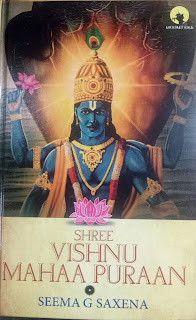
Book Review of Shree Vishnu Mahaa Puraan


Shree Vishnu Mahaa Puraan by Seema G. Saxena is one of the most well researched books that I have read in recent times. It is a translation from the Sanskrit version but with a difference. The language is simple enough for anyone to read, and for people interested in Hindu mythology, it is a blessing. The entire narrative has been divided into six sections and it makes for interesting reading. The author’s grip over both the languages, Sanskrit and English, is there to be seen as we progress from chapter to chapter. Starting from the creation of the universe with twenty four elements, the narrative travels through the formation of the Bhaarat Varsh, the Sun and Moon dynasties, and ends with a peek into life and people during Kaliyug and then the detailing of the process of dissolution of the universe. There are some well known stories with content that is not commonly written about. Being a devotee of Sri Krishna, the Section five held an additional attraction for me. The book has been brought out in hard cover by Locksley Hall Publishing  and the cover design is evocative.  I loved the book and would recommend it to anyone who has a genuine interest in reading our ancient Hindu scriptures and understanding them.

My rating for this book is a perfect 5/5

The link

https://www.amazon.in/SHREE-VISHNU-MAHAA-PURAAN-SAXENA/dp/8195306519/


#BookReview #Shree_Vishnu_Mahaa_Puraan #LockleyHallPublishing #SeemaSaxena


My rating for this book is a perfect 5/5

Monday, October 4, 2021

Reopening of school for Std. 8th to 12th from today in Mumbai - Education


After a full year and a half of online lessons, students of the 8th to 12th are being allowed to attend physical school from today in Mumbai. The children are really excited to be in the midst of their friends once again, but some parents are still wary of this move. With the Government having insisted that parents have to give consent to their child attending physical school, the school authorities have put it forward to parents. In a survey by Ed Tech Firm, LEAD, reported by Midday recently, around 67% parents want their children to attend school, while the others want the online classes to continue for some more time.

The main area of concern seems to be physical distancing, complete vaccination of teaching staff, health facilities and Covid 19 preparedness of the school, along with the oncoming festive season. Many schools have therefore opted to open in November after the end of the festive season, which seems quite fine, as it gives them the time to ensure that the safety protocols are in place. However, lots of schools in the city have already made arrangements to welcome their students back to school from today.

A decision on opening of schools for smaller children is yet to be taken. Colleges too may open only after the festive season with vaccination being a pre requisite for attendance for students above 18 years of age.   

Do share your views.

Sunday, April 25, 2021

Chitra Pournami is a festival dedicated to the worship of Lord Chitragupta with recipe of Sarkarai Pongal

 Chitra Pournami is a unique festival celebrated across Tamil Nadu dedicated to the worship of Chitragupta. Chitra Pournami is celebrated on the full moon day of the month of April-May (Chitirai Masam in Tamil), believed to be his birthday.  This year it falls on 26th &27th April. The pournami  thithi  starts on 26th afternoon and ends on 27th morning.


Chitragupta is said to diligently record and maintain the account of the good and bad actions performed by every human being who is born on this earth. On the completion of a person’s life time, Chitragupta prepares the final report to be presented to Lord Yama. This forms the basis for the God of Death to decide the fate of that particular individual.
People celebrate this festival by taking bath in holy rivers to wash off their sins and offer special pujas and prayers at temples. Interestingly, some of the temples dedicated to worship of Chitragupta are the Chitragupta Temple on Nellukara Street, Kanchipuram, Chitragupta Mahadeva Devalayam in Hyderabad, Chitragupta temple at Kajuraho, and Chitragupta Maharaj Temple at Chitragupta Ghat on the banks of the Gandak river in Hajipur, Bihar.
In the temple at Kanchipuram, the main deity of Shri Chitragupta is depicted in a seated position with a palm leaf in his left hand and a pen in his right hand. The utsava murthy  of the Lord with his wife Karnika Ambal is beautiful.  Priests and devotees offer Sarkarai Pongal and other delicacies without salt as neivedyam for the Lord.
There is another legend associated with this festival pertaining to Lord Indra and his Guru, Brihaspathi. The story goes that they had an argument, after which the Dev Guru refrained from giving advice to Lord Indra.  Bereft of the wisdom and proper advice of his Guru, Lord Indra committed various sins. Later he realized his folly and sincerely repented for his mistakes. Out of sympathy and compassion the Dev Guru resumed his duties and advised Devraj Indra to undertake a pilgrimage on Earth. After a long journey, at a certain place, Devraj Indra sensed that he had been redeemed of his sins. He found a Shivalingam under a Kadamba tree and wanted to offer puja to the Lord in gratitude. He looked around and surprisingly, in a pond nearby, he found a golden lotus. He worshipped the Lord with the golden lotus. The place was the holy city of Madurai and the day was the auspicious Chitra Pournami day. Even today this divine event is commemorated with an Indra Puja on Chitra Pournami day at the Madurai Meenakshi temple.
Here is the Recipe of Sarkarai Pongal which is the main neivedhyam offered to Lord Chitragupta on Chitra Pournami day.
Sarkarai Pongal


Ingredients:
Raw Rice – 1 cup
Yellow Moong Dhal – 1/4 cup
Milk – 1/2 cup
Water - 2 cups
Jaggery – 2 cups (grated)
Cashews – 3 tablespoons
Raisins – 3 tablespoons
Powdered Cardamom – ½ teaspoon
Ghee – 3 tablespoons


Method:
Roast the moong dhal in a teaspoon of ghee till it slightly changes color. Remove on to a bowl and soak it along with raw rice in water for 10 minutes. Strain it to remove water.
Take a vessel and boil milk. Add  the soaked and strained rice and dhal to the milk and water and cook  till the rice is fully cooked. Mash it up with a spoon and keep aside. Alternatively you can cook the rice, dhal with milk and water with a teaspoon of ghee in a pressure cooker for 4 or 5 whistles. 
In a separate bowl add the jaggery to water and bring to a boil. Strain to remove impurities. Add this jaggery water to the milk, rice and dhal mixture. Stir well on a low flame till they are completely mixed.
Take a pan and pour the rest of the ghee in it. Fry Cashews and raisins in the ghee to a golden brown and add to the pongal mixture. Stir on low flame till they blend well. Add cardamom powder and mix.
Your Sakkarai Pongal offering is ready.

#ChitraPournami #Chitragupta #Kanchipuram #SarkaraiPongal #Recipe